Sarah thought she had it figured out. Home-based therapy sessions, familiar surroundings, their son Alex comfortable in his own space. But three months in, she was questioning everything. The therapist arrived late twice that week. Alex kept getting distracted by his toys in the next room. And honestly? Sarah found herself stress-cleaning before every session, worried about what the therapist might think of their perpetually chaotic kitchen.
This is where a lot of families find themselves. Torn between what feels right emotionally and what might work better practically.
The infrastructure question
Here’s what nobody talks about upfront: running effective therapy requires infrastructure. Not just a quiet room, but specialized equipment, backup plans when things go sideways, and systems that don’t depend on your WiFi working perfectly or your neighbor’s dog not barking during session time.
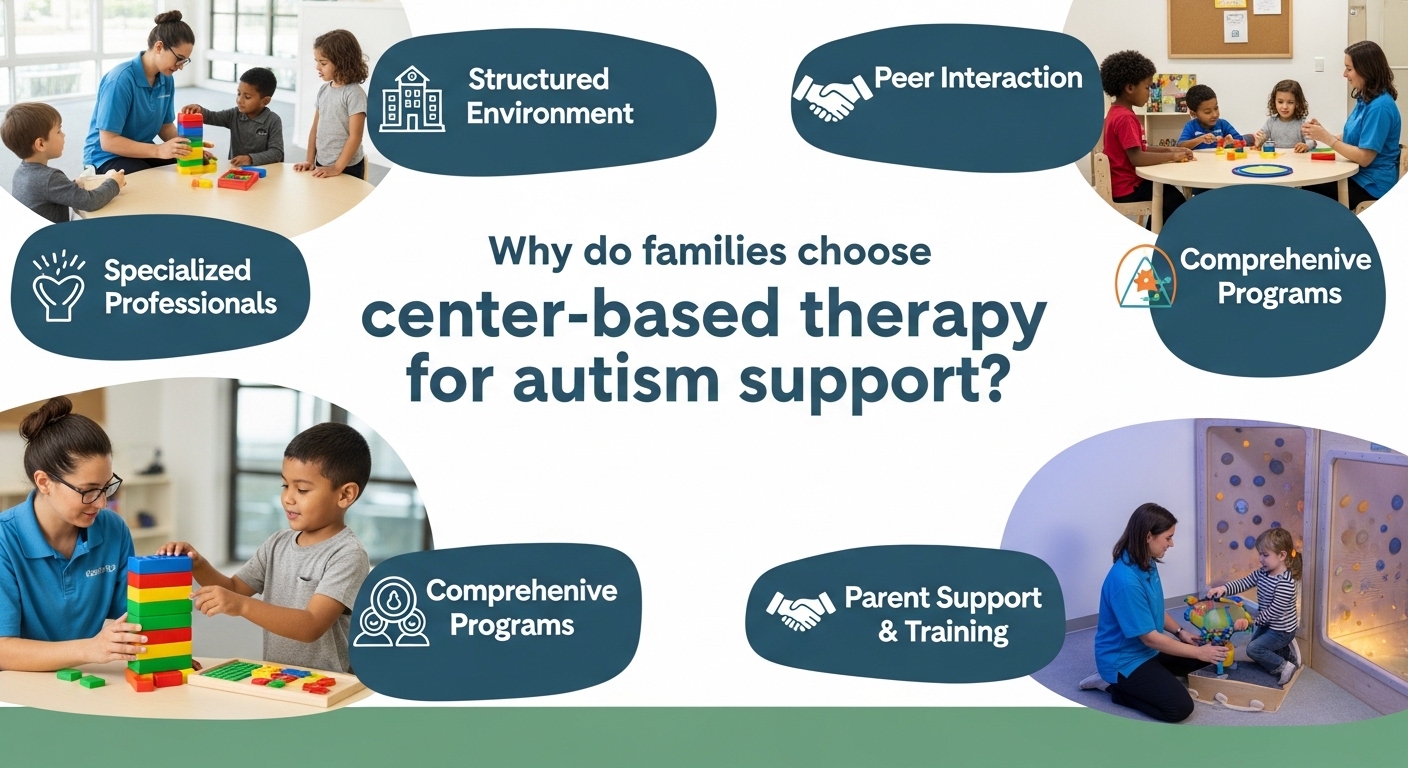
Center-based programs come loaded with this infrastructure. They’ve already solved the logistical puzzles that trip up home-based setups. Need a sensory break room? They have one. Specialized communication devices? Check. Multiple therapists available if someone calls in sick? Built in.
Look, I’m not saying centers are inherently superior to home-based care. But they are purpose-built for this work in ways that most homes simply aren’t.
Why does peer interaction spark such dramatic breakthroughs?
Alex’s breakthrough came during snack time. Something I find genuinely fascinating about how children learn from each other. Another child at the center started using sign language to request crackers, and Alex watched, mesmerized. Within two weeks, he was signing “more” and “please” consistently, as if observing his peer had unlocked something that months of direct instruction couldn’t touch.
This peer modeling effect slips through the cracks of home-based therapy like water through cupped hands. Children with autism often absorb lessons differently when they’re watching other kids navigate the same challenges, rather than receiving instruction from adults who seem to effortlessly master everything. There’s something about witnessing another child struggle, then succeed, that makes the impossible feel suddenly within reach.
Centers naturally cultivate these modeling opportunities. They create a community where kids see others working through similar challenges, celebrating small victories, using coping strategies that actually work in real time.
Structure as a teaching tool
The predictability of center-based programs isn’t just convenient. It’s therapeutic in ways that genuinely surprise me, even after years of observing this work.
Many children with autism thrive on routine, but creating and maintaining that routine at home while juggling work responsibilities, sibling dynamics, and life’s relentless chaos? Absolutely exhausting. Centers weave structure into their very foundation: same schedule, same transitions, same expectations day after day, creating a cocoon of predictability that allows learning to flourish.
This consistency helps children generalize skills across different settings. When Alex learned to follow a visual schedule at an aba center in boston, ma, he wasn’t just memorizing the specific routine. He was mastering visual schedules as a universal tool. A skill that rippled outward to home, to school, to entirely new situations.
The intensity factor
Most center-based programs deliver more intensive hours than their home-based counterparts. Instead of three scattered one-hour sessions per week, families might access six concentrated hours daily. That compression of therapy time can accelerate progress dramatically, particularly for children who need repetition and practice to cement new skills.
But intensity is more than just quantity. It’s about the quality of that concentrated time, the purity of focus that emerges when those six hours are purely therapeutic. No interruptions from delivery drivers. No sibling meltdowns bleeding into the background. No temptation to check email quickly while the therapist works with your child.
The therapeutic space becomes sacred. Protected.
When centers stumble
Centers aren’t magic, though. This genuinely frustrates me when I see families sold unrealistic expectations. Some children absolutely flourish in familiar environments. Some families desperately need the flexibility that comes with home-based services. And let’s acknowledge the elephant in the room: center-based care often demands commuting, which layers additional time and stress onto already stretched schedules.
The most effective programs recognize these limitations. They weave in parent training components, offer transition support, and work actively to help children transfer skills to home and community settings. Because what’s the point of mastering a skill in one isolated environment?
The choice isn’t set in stone
Sarah eventually grasped something important. The choice between center-based and home-based therapy isn’t a permanent life sentence.
Families can begin with centers and gradually transition to home-based care as children develop greater independence. Or flip the script entirely. What matters most is aligning the setting with the child’s evolving needs and the family’s shifting capacity. Both change, sometimes dramatically, sometimes in unexpected directions.
Some kids crave the structure and intensity of centers initially, then benefit from home-based flexibility later. Others thrive with the opposite progression. Which makes sense, actually.
The best therapy happens where children can focus, learn, and genuinely grow. Sometimes that’s home. Sometimes it’s a specialized center. Often, it’s a thoughtful combination of both, adapted over time as needs shift and children surprise us with their resilience.