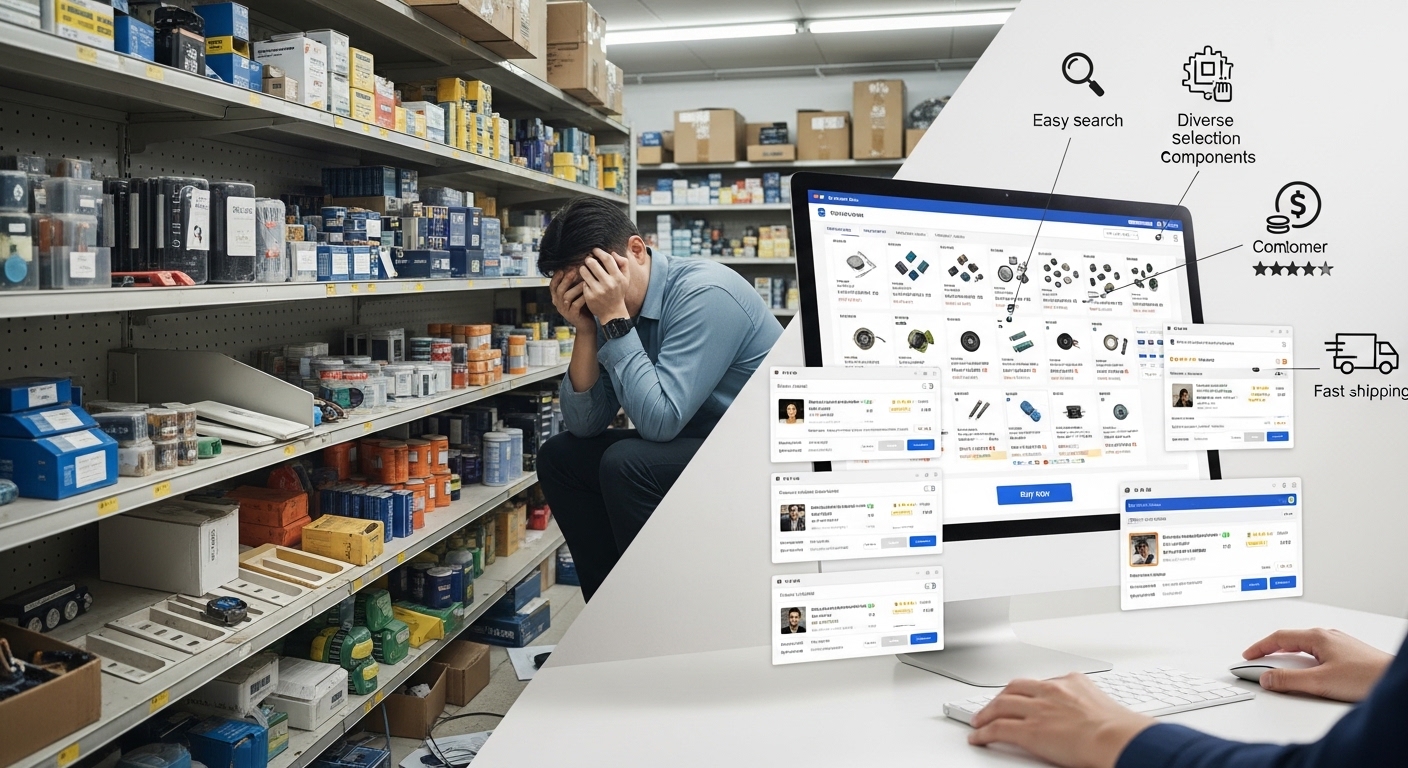
Three years ago, I watched an engineer spend four hours driving across town to three different electronics stores, hunting for a specific capacitor. He came back empty-handed and frustrated. The part he needed? Available online with next-day shipping for half what the local shops were charging.
That moment crystallized something I’d been mulling over. The old way of sourcing components feels increasingly like swimming upstream against a current that’s only getting stronger.
Why does geography still matter when it shouldn’t?
Physical electronics stores are vanishing faster than morning mist. Radio Shack’s collapse wasn’t an anomaly, it was a preview of coming attractions. Even in major metropolitan areas, you’re lucky to find two decent component suppliers within reasonable driving distance. Live somewhere that isn’t a tech hub? Good luck.
Online stores obliterate geography with surgical precision. Doesn’t matter if you’re in Silicon Valley or rural Montana—you get access to identical inventory, identical pricing, identical technical specs. The playing field levels out in ways that would have seemed like science fiction two decades ago.
Which brings me to something that genuinely surprised me.
Inventory depth that makes warehouse managers weep
Physical stores operate under brutal constraints. Square footage costs money. Every component sitting on a shelf represents capital tied up like a hostage. So they stock the basics and maybe some popular specialty items. Want something even slightly obscure? “We can order it for you.”
Makes sense, actually. But it’s also maddening.
Online retailers can afford to stock thousands of variants because their warehouses aren’t hemorrhaging cash on downtown retail rent. They can carry 47 different types of resistors instead of just 12. They maintain inventory of low-volume, specialty components that would never justify precious shelf real estate in a physical store.
I’ve seen online catalogs with component counts that utterly dwarf entire electronics districts. And they’re searchable. Filterable. You can narrow down from 50,000 options to exactly what you need in under a minute.
Try doing that with a yellowed paper catalog from 1987.
Information flips the script completely
Remember when buying components meant relying on whatever knowledge the store clerk happened to possess? Maybe you’d get lucky and find someone who actually understood what you were building. More often? Vacant shrug and “let me check the back.”
Online stores weaponize information in ways that border on overwhelming. Detailed specs cascade down the page. Multiple high-res photos reveal every microscopic detail. Cross-reference charts map component relationships. Application notes written by engineers who’ve wrestled with real-world problems. User reviews from people who’ve actually deployed these parts in live projects, complete with failure modes and workarounds.
Some platforms even show what other components people typically buy alongside the one you’re examining. Like having an experienced engineer peering over your shoulder, minus the awkward small talk.
You become the expert. Information flows directly to you instead of trickling through some human bottleneck.
Trust remains everything
But this is where online component buying gets treacherous.
Anyone with basic web skills can throw up a website and claim to sell electronic components. The barrier to entry hovers near zero, which means quality varies wildly. I find this both liberating and terrifying.
Established suppliers like the Fusion electronic components shop build reputations over years through consistent quality and reliable service. They understand that selling counterfeit or substandard parts destroys trust permanently. One bad batch can torpedo a supplier’s reputation faster than they can rebuild it.
Smart money goes to suppliers with proven track records. Companies that have weathered economic storms and supply chain disruptions without losing their footing. Organizations that provide real technical support rather than just order processing.
Price transparency cuts deep
Online shopping makes price comparison almost embarrassingly trivial. Five suppliers in five minutes. This transparency forces retailers to compete on actual value rather than information hoarding.
It also exposes uncomfortable truths about component pricing. That resistor you’ve been buying for $2 at the local shop? Available online for $0.47 in single quantities. The markup in physical retail can be genuinely breathtaking once you start doing systematic comparisons.
Course, online prices don’t always win. Shipping can eat up savings, especially for small orders. And certain specialty or rush situations still favor local sources.
The speed paradox nobody predicted
Here’s something that defies intuition: online ordering often beats local sourcing for pure speed, even when components must travel through shipping networks.
Do the math. Driving to a physical store takes time. Browsing their limited inventory takes more time. Waiting for them to special-order hard-to-find components? That’s where time goes to die.
Meanwhile, you can place an online order in three minutes and have parts show up the next morning. The calculus shifts when you factor in opportunity cost. Your time has value. Sometimes paying for premium shipping costs less than burning half a day on urban component hunting.
The component sourcing world has split into two camps: those who embraced online reality and those who clung to outdated models. Guess which group thrives while the other fades away?