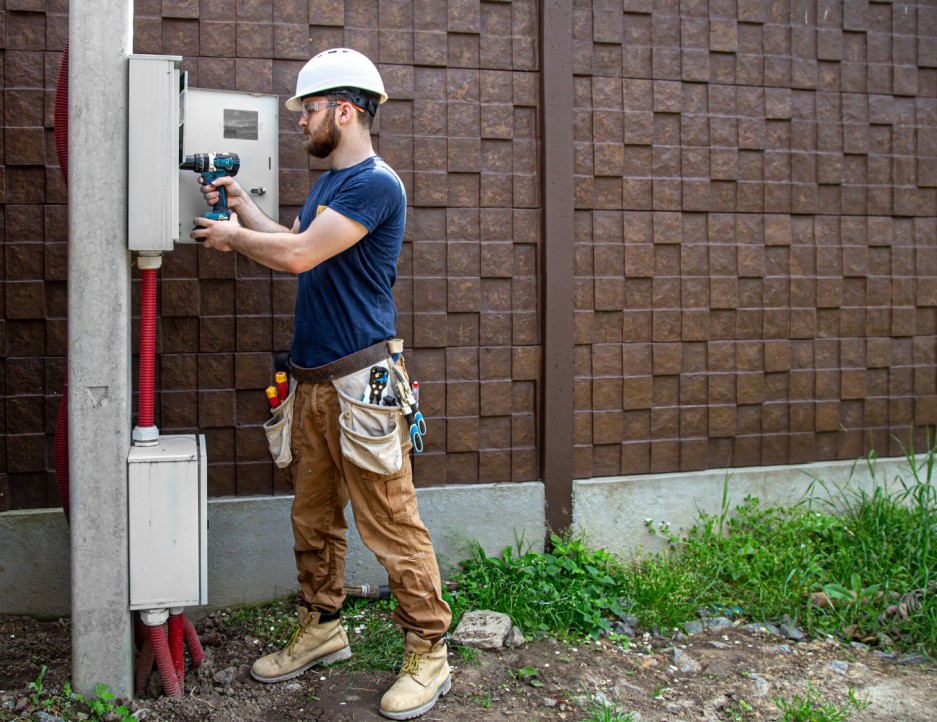
If you are adding a charger and a spa to a rental cabin, the equipment is not the part that decides your timeline. The electrical service feeding the building is. I found that out on a Table Rock lakeside cabin I was splitting into two guest units, and the fix started with the civil contractors hollister mo hosts end up calling once a power provider asks for a buried service run. Both amenities together cost me less than the three hundred feet of trench that made them usable. That is the argument of this whole piece: price the service run first, and the rest of the upgrade stops being a guess.
Service Capacity Is The First Amenity Question
The listing copy was already written. Someone had ordered the spa that same week. Nobody had opened the meter base, which was feeding a hundred amp service installed back when the cabin was a weekend fish camp. A sixty amp charger plus a spa on a fifty amp circuit does not fit behind that, and the provider’s answer was not a bigger breaker but a new service run from a pole three hundred feet up the hill. So the spa sat under a tarp on the gravel drive for six weeks, sulking.
Two things about that run are not negotiable, and both are safety rather than preference. Nothing goes in the ground until the lines are located and marked, and OSHA’s excavation standard at 29 CFR 1926.651 requires that the estimated location of utility installations be determined and the utilities contacted to mark buried electric, gas, water and sewer lines before digging begins. Call 811 first, every time. The service conductors between the pole and the meter belong to the utility and to a licensed electrician; an owner does not touch them, energized or not. On my lot the locate turned up an abandoned gas stub nobody had recorded, eight feet off the path we had already chalked.
Translating The Utility Language Into A Scope
The provider’s letter is short, and it assumes you speak its language. Mine asked for a trench to the point of delivery, which is just the spot where their wire ends and mine begins, plus conduit sized to their spec and a meter base set where a bucket truck can reach it. What usually turns up, job after job on these lake lots, is that the owner reads that as one task while the utility means four: locate, trench, conduit, inspection, and then the service drop itself on the provider’s own calendar. A dry utility crew reads the same letter as a scope of work and prices it out. Which is why I now tell people to search civil contractors hollister mo before they buy the spa rather than after the utility writes back. (Yes, I had already paid for the spa cover. Learn from me.)
The spa brought paperwork of its own. A ContractorGearLab article from April 2026 laid out the pool and spa electrical rules, and the one that catches owners off guard is bonding: under NEC Article 680, metal parts within 5 feet of the waterline have to be tied together with a copper conductor of at least 6 AWG so a fault cannot put a voltage difference across somebody standing in the water. Which edition your inspector works from, and what your county asks for on top of it, varies by jurisdiction, so put the question to the building department before any concrete goes down. My point is narrower than the code, though. The bonding grid, the conduit and the service run all want to happen in the same week and in the same hole, and they only manage that if one person is sequencing them.
Running The Numbers On A Buried Service Run
Here is the arithmetic I wish I had run in week one, using round numbers off my own quotes rather than anything you should treat as a rate card. Three hundred feet of trench at roughly $12 a foot came to $3,600. Conduit, the pull, backfill and pathway marking added about $2,200. A two hundred amp meter base and panel upgrade ran $2,800, and the spa’s own bonded circuit and disconnect another $1,150. Call it $400 for permits and locate coordination. That comes to $10,150 all in, against a spa and a charger that together were under $9,000. Two booked nights across a two unit cabin at peak Table Rock season covers a fair slice of that, which is the only reason the total did not ruin my month.
Trench Once And Pull Everything At Once
The saving here is not in the equipment. It is in how many times the ground gets opened. We put the service conductors, the spa feed, a spare conduit for fiber and a sleeve under the new parking pad in that same three hundred foot trench, and the second unit’s future subpanel got a conduit stub while the machine was still on site. Opening one trench once is the cheapest decision on the whole project. Reopening it later for internet or a second charger would have cost most of the trenching over again, at a point when the cabin is booked solid and the yard is finally landscaped. Sequence it service first and amenities second, and a stalled summer turns back into a scheduled week of work.