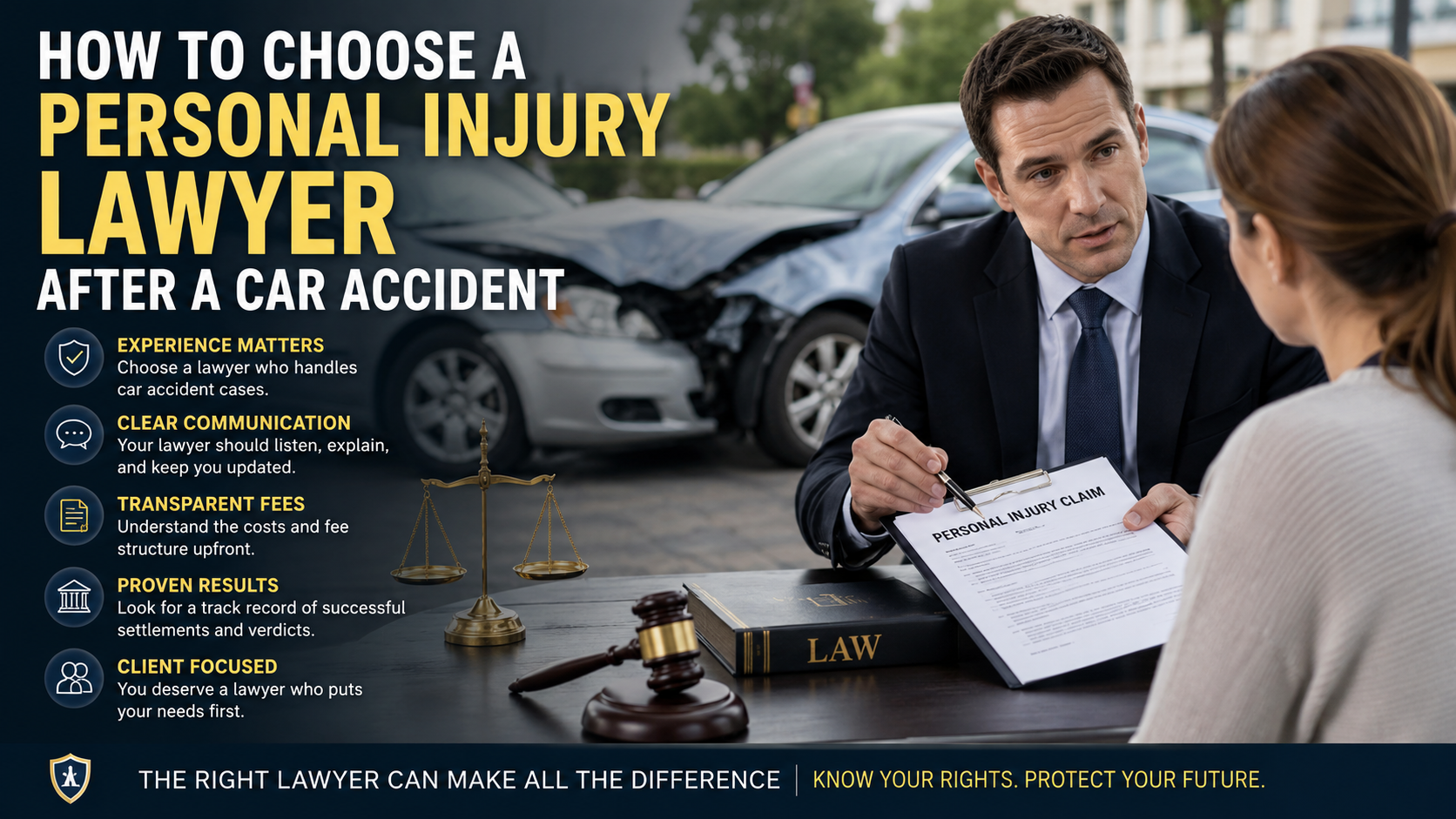
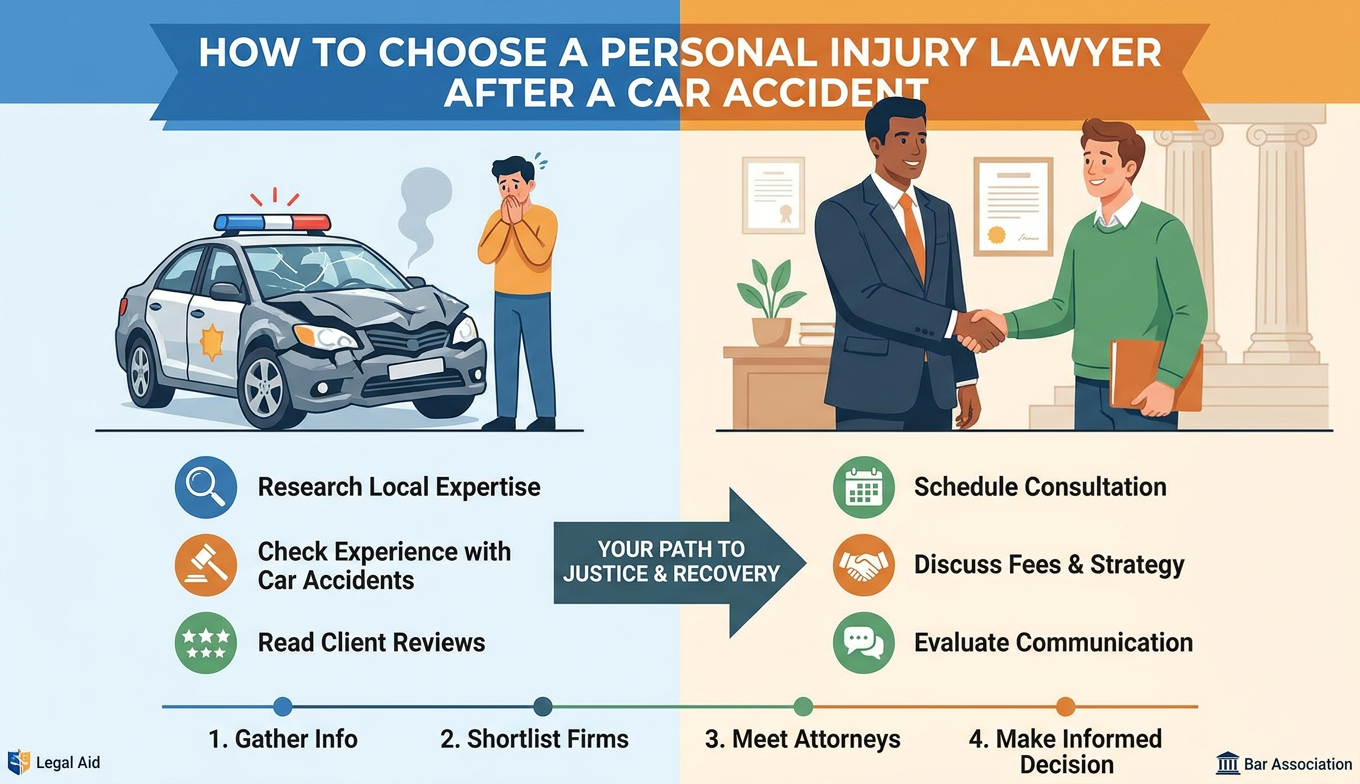
Choose a personal injury lawyer who regularly handles car accident claims, has a valid license and good professional standing, explains fees clearly, communicates well, and has experience with cases similar to yours.
The right lawyer should also be prepared to negotiate with insurers and take the case to court when necessary.
What Does a Personal Injury Lawyer Do After a Car Accident?
A personal injury lawyer represents an injured person who may have a legal claim for compensation after an accident. In a car accident case, the lawyer may investigate what happened, identify who may be legally responsible, collect evidence, communicate with insurance companies, calculate losses, negotiate a settlement, and file a lawsuit when appropriate.
A lawyer does not simply complete paperwork. A strong accident claim often depends on proving several important facts.
The case may require evidence showing:
- Who caused the crash.
- Whether another person or company was legally responsible.
- What injuries resulted from the crash.
- What medical treatment was required.
- How the injuries affected work and daily life.
- What financial losses occurred.
- Whether another insurance policy may provide coverage.
- Whether the amount offered by an insurer is fair.
Auto insurance commonly includes bodily injury liability, property damage liability, and uninsured or underinsured motorist coverage, although the available coverage and legal requirements depend on the policy and jurisdiction.
A lawyer can help connect these facts into a legal claim supported by records and evidence.
Do You Need a Lawyer After a Car Accident?
Not every car accident requires a lawyer. A person with minor property damage and no significant injury may be able to deal with an insurance claim without legal representation.
Legal advice becomes more important when the accident involves significant injuries, disputed fault, a complicated insurance issue, multiple vehicles, a commercial vehicle, a death, long term medical treatment, or a disagreement about the value of the claim.
A lawyer may also be useful when the insurance company denies the claim or makes an offer that does not cover the losses supported by the evidence.
The decision should not be based only on the size of the vehicle damage. A car can have limited visible damage while an injured person has substantial medical or financial losses.
When Should You Hire a Personal Injury Lawyer?
There is no universal deadline that applies to every car accident claim. Legal deadlines depend on the jurisdiction and the type of claim. A statute of limitations can prevent a claim from being brought after the applicable period expires.
For this reason, an injured person should not wait until the deadline is close before finding out what legal rights may apply.
Consider speaking with a personal injury lawyer promptly when:
| Situation | Why legal advice may matter |
|---|---|
| Serious physical injury | Medical costs and future losses may be substantial |
| Long term treatment | The final value of the claim may not be clear early |
| Disputed fault | Evidence may be needed to establish liability |
| Multiple drivers | Responsibility and insurance coverage can become more complicated |
| Uninsured driver | Additional insurance coverage may need to be examined |
| Underinsured driver | The other driver’s policy may not cover the full loss |
| Permanent injury | Future medical and financial effects may require careful evaluation |
| Lost income | Employment records and future earning issues may need documentation |
| Wrongful death | Different legal claims and procedures may apply |
| Insurance denial | The reason for the denial needs to be reviewed |
| Low settlement offer | The offer should be compared with documented losses |
| Lawsuit risk | Court procedures and deadlines become important |
The earlier a lawyer understands the facts, the easier it may be to identify evidence that needs to be preserved.
How Do You Find a Personal Injury Lawyer?
Start with several possible lawyers rather than hiring the first person who appears in a search result.
The Federal Trade Commission recommends looking for lawyers with relevant experience, checking state and local bar associations, using lawyer referral services, and speaking with more than one lawyer before making a decision.
The American Bar Association also maintains a lawyer referral directory that connects people with state and local bar association referral services.
Useful sources include:
State Bar Associations
A state bar association can help you locate lawyers licensed to practice in the relevant jurisdiction. Bar records may also provide information about professional discipline.
The ABA states that each state maintains current registration and discipline information for lawyers licensed in that state.
Lawyer Referral Services
Referral services can provide names of lawyers who practice in a particular area of law. Some referral programs may have requirements for participating lawyers.
Personal Referrals
A recommendation from someone you trust can be useful, especially when that person had a similar legal problem. A lawyer who does not handle personal injury cases may also refer you to another attorney with the right experience.
Online Research
Online research can help you compare practice areas, professional history, office information, published legal work, client information, and other public details.
A website alone should not determine your decision. A polished website does not prove that a lawyer is the best choice for your case.
What Type of Lawyer Should You Choose?
Look for a lawyer whose practice includes personal injury and motor vehicle accident claims.
Personal injury is a broad area of law. Some lawyers focus mainly on medical malpractice, employment disputes, business matters, criminal law, or other legal areas. Relevant experience matters because legal rules, evidence, insurance issues, and common defenses can differ between types of cases.
The ABA’s professional conduct guidance states that competent representation requires the legal knowledge, skill, thoroughness, and preparation reasonably necessary for the matter. The guidance also recognizes that the complexity and specialized nature of a case can affect the level of knowledge and skill needed.
For a car accident claim, ask whether the lawyer regularly handles cases involving:
- Motor vehicle collisions
- Serious bodily injuries
- Insurance disputes
- Uninsured or underinsured motorists
- Commercial vehicles
- Distracted driving
- Road or vehicle defects
- Wrongful death
- Permanent disability
- Disputed liability
The closer the lawyer’s experience matches your circumstances, the more useful the consultation is likely to be.
How Important Is Experience With Cases Like Yours?
Experience should be specific, not just general.
A lawyer may have practiced for many years but handle only a small number of car accident cases. Another lawyer may have fewer years in practice but regularly represent people injured in motor vehicle crashes.
Ask:
“How many car accident cases like mine have you handled?”
Then ask:
“How many went to trial?”
These questions reveal more than simply asking how many years the lawyer has practiced.
You can also ask whether the lawyer has handled injuries similar to yours and whether the firm has experience with the insurance issues involved in your claim.
Past results are not guarantees. Ethical rules restrict lawyers from making misleading promises about future results. A record of past cases can provide useful background, but it cannot tell you exactly what your own case will be worth.
Does Trial Experience Matter?
Yes, particularly when the other side disputes responsibility or refuses to offer a reasonable settlement.
Most civil injury matters are resolved without a trial, but a lawyer should understand how a case would be prepared for court if negotiations fail. The American Bar Association notes that personal injury lawyers commonly use contingency arrangements and that many personal injury cases are resolved through negotiation rather than trial.
Ask a lawyer:
“Will you take my case to trial if a fair settlement cannot be reached?”
Also ask:
“Who in your firm would handle the trial?”
A lawyer who advertises trial experience should be able to explain the firm’s actual role in cases without making unsupported promises about your result.
How Should You Check a Lawyer’s License and Disciplinary Record?
Verify the lawyer through the appropriate state licensing or disciplinary authority.
The ABA advises consumers that state records provide information about lawyer registration and discipline.
Check:
- Whether the lawyer is currently licensed.
- Whether the lawyer is authorized to practice in the jurisdiction relevant to the case.
- Whether disciplinary information is publicly available.
- Whether the lawyer’s current contact information matches official records.
- Whether the firm’s information is consistent across reliable sources.
A disciplinary history does not automatically answer whether a lawyer is suitable for your case. The nature, date, and outcome of any disciplinary matter should be understood before drawing conclusions.
What Should You Look for During the First Consultation?
The first consultation is an opportunity to evaluate both the case and the lawyer.
Many lawyers offer an initial consultation without charging a fee, but the FTC recommends understanding the terms before arranging the meeting.
Bring as much relevant information as you can.
Useful documents may include:
- Police or crash reports
- Insurance policy information
- Insurance correspondence
- Photos and videos from the scene
- Photographs of vehicle damage
- Medical records
- Medical bills
- Prescription records
- Repair estimates
- Proof of lost income
- Employment records
- Witness contact information
- Information about the other driver
- Copies of messages or letters from insurers
You do not need to prove the entire case before meeting the lawyer. The purpose of the consultation is to give the lawyer enough information to identify important legal and factual issues.
What Questions Should You Ask a Personal Injury Lawyer?
A good consultation should involve clear questions and clear answers.
| Question | What the answer can tell you |
|---|---|
| How many car accident cases have you handled? | Relevant experience |
| Have you handled injuries like mine? | Experience with similar medical issues |
| Who will handle my case? | Actual case responsibility |
| Will I work directly with you? | Communication structure |
| How often will I receive updates? | Expected communication |
| What problems do you see in my case? | Risk assessment |
| How will you investigate the accident? | Case preparation |
| How will you prove liability? | Legal and evidence strategy |
| How are your fees calculated? | Financial obligations |
| What other costs may I have to pay? | Expenses beyond the legal fee |
| What happens if we do not win? | Risk of unpaid costs |
| Will you take the case to trial if needed? | Litigation capability |
| How long could the process take? | Realistic expectations |
| Who makes the final decision to settle? | Client control |
| Will another lawyer work on the case? | Firm structure |
| Do you have a conflict of interest? | Independence and ethics |
The strongest answers are usually specific. Be cautious when an attorney avoids basic questions about fees, case handling, or professional responsibility.
Who Will Actually Handle Your Case?
The lawyer you meet during a consultation may not personally perform every task.
A larger law firm may use several attorneys, paralegals, investigators, legal assistants, and outside experts.
That is not automatically a problem. The important point is to understand who has responsibility for the case.
Ask:
“Who will be my main attorney?”
“Who will contact me with important updates?”
“Who will negotiate with the insurance company?”
“Who will prepare the case if a lawsuit is filed?”
“Who will handle a trial?”
The ABA Model Rules emphasize competent representation and explain that when lawyers work together, the scope of their roles and responsibilities should be addressed appropriately.
How Important Is Communication?
Communication should be a major part of your decision.
A lawyer should explain legal matters well enough for the client to make informed decisions. Under ABA Model Rule 1.4, lawyers should keep clients reasonably informed, respond to reasonable requests, and explain matters as needed for informed decisions.
During the consultation, notice whether the lawyer:
- Listens to the facts.
- Answers questions directly.
- Explains legal terms clearly.
- Discusses weaknesses as well as strengths.
- Explains what happens next.
- Tells you who will handle communication.
- Gives you reasonable expectations about timing.
Communication is especially important after a settlement offer arrives. A client needs enough information to understand the offer and make an informed decision.
How Do Personal Injury Lawyers Charge?
Many personal injury lawyers use a contingency fee.
Under a contingency fee arrangement, the lawyer’s fee depends on recovery rather than an hourly payment. The ABA explains that contingency fees are commonly used in personal injury matters and are often calculated as a percentage of the amount recovered.
The percentage varies by lawyer, jurisdiction, case complexity, and the stage at which the case resolves.
The agreement may use different percentages for:
- Settlement before a lawsuit.
- Settlement after a lawsuit.
- Trial.
- Appeal.
Never assume that “no win, no fee” means there will be no other financial obligations.
What Costs Can Come Out of a Personal Injury Settlement?
Legal fees and case expenses are separate issues.
Expenses can include costs associated with obtaining records, filing documents, depositions, expert witnesses, investigation, and other litigation services. The ABA advises clients to understand how these expenses will be handled under the fee agreement.
Ask exactly:
“Are case expenses deducted before or after your percentage is calculated?”
“Do I pay expenses if the case is unsuccessful?”
“Which expenses will the firm advance?”
“Can expenses be deducted from my settlement?”
“Will I receive an itemized statement?”
The American Bar Association’s professional conduct rules address written contingency fee agreements and require the agreement to explain the method used to determine the fee and how litigation expenses are handled.
A Simple Fee Example
Suppose a claim produces a $100,000 recovery and the written agreement provides for a 33 percent attorney fee.
The attorney fee would be $33,000 before considering any separate case expenses, assuming the agreement calculates the fee directly from the full recovery.
That would leave $67,000 before other applicable deductions.
The actual calculation can differ because fee agreements and state rules differ. A written agreement controls the relationship, subject to applicable law and professional rules.
What Should Be Written in the Fee Agreement?
Read the agreement before signing it.
The document should make important financial terms understandable.
Look for:
| Term | What to confirm |
|---|---|
| Attorney percentage | Exact percentage or percentages |
| Settlement stage | Whether the percentage changes after filing |
| Trial fee | Whether trial changes the percentage |
| Expenses | What expenses are charged |
| Expense timing | When costs are deducted |
| No recovery | What happens if there is no recovery |
| Client costs | Which charges you may owe personally |
| Referral fees | Whether another lawyer shares the fee |
| Case termination | What happens if you end the relationship |
| Settlement authority | Who makes the final settlement decision |
The ABA states that contingent fee arrangements should clearly explain the percentage, expenses, and whether expenses are deducted before or after the contingency fee is calculated.
Do not sign an agreement you do not understand.
What Resources Should a Good Law Firm Have?
A complicated car accident case may require more than one person’s work.
Depending on the facts, a firm may need access to investigators, medical experts, accident reconstruction professionals, economists, vocational professionals, or other specialists.
The lawyer should decide whether outside expertise is actually necessary. Not every case requires experts.
Ask:
“Will you investigate the accident?”
“Can you obtain relevant records?”
“Do you work with accident reconstruction experts?”
“Can you use medical experts when necessary?”
“Who pays these expenses while the case is pending?”
The ABA’s competence guidance recognizes that lawyers may associate or consult with lawyers who have established competence in a particular area when necessary for competent representation.
How Does a Lawyer Evaluate the Value of a Car Accident Claim?
There is no reliable universal settlement amount for every car accident.
The value of a claim depends on the facts and applicable law.
Important factors can include:
- Medical expenses.
- Future medical needs.
- Lost wages.
- Loss of future earning ability.
- Property damage.
- Physical pain.
- Functional limitations.
- Long term effects.
- Evidence of liability.
- Insurance coverage.
- Comparative or contributory fault rules where applicable.
- Available evidence.
- Applicable legal deadlines.
An attorney should be able to explain the factors that may increase or reduce the value of the claim without promising a specific result.
Why Should You Be Careful With Early Settlement Offers?
An insurance company may make an offer before the full effect of an injury is known.
That does not automatically mean the offer is unfair. However, an injured person should understand what the settlement would cover before accepting it.
A settlement may resolve the legal claim. The terms of the agreement therefore matter.
Ask:
“What claims am I giving up by signing this?”
“Will I still be able to pursue additional compensation for future treatment?”
“Are medical liens or other claims being considered?”
“How will outstanding bills be handled?”
“Is the settlement intended to resolve all claims?”
A lawyer can review these issues under the applicable law before you make a decision.
How Does an Insurance Company Fit Into the Claim?
Insurance is often central to a car accident claim.
The National Association of Insurance Commissioners explains that auto insurance can include bodily injury liability, property damage liability, and uninsured or underinsured motorist coverage.
An accident claim may therefore involve more than asking the other driver to pay personally.
A lawyer may review:
- The at fault driver’s policy.
- Your own auto insurance policy.
- Uninsured motorist coverage.
- Underinsured motorist coverage.
- Other potentially applicable policies.
- Policy limits.
- Coverage exclusions.
- Insurance correspondence.
- Claim denials.
Coverage questions can become difficult when several policies may apply.
Should You Talk to the Other Driver’s Insurance Company?
Be careful about giving detailed statements before you understand your legal position.
After a crash, insurance companies may contact people involved in the accident. The safest approach is to provide accurate information and avoid guessing about facts you do not know.
Do not deliberately exaggerate, hide relevant facts, or provide false information.
The NAIC advises drivers to collect key information after a crash, including the other driver’s identifying and insurance information, and to report necessary information to their insurer.
When injuries are serious or fault is disputed, legal advice can help you understand how communications with insurers may affect the claim.
What Evidence Should Your Lawyer Review?
Evidence can determine whether an accident claim is strong, weak, or disputed.
Important evidence may include:
Crash Reports
Police or crash reports can provide information about the location, drivers, vehicles, witnesses, and circumstances reported after the collision.
Photographs and Video
Photos can show vehicle damage, road conditions, traffic signs, lighting, visible injuries, and other physical evidence.
Dashcam footage, security camera footage, and cellphone video can also become important when available.
Medical Records
Medical documentation can establish the nature of injuries, diagnosis, treatment, prognosis, and related expenses.
Witness Information
Independent witnesses may provide evidence about how the collision happened.
Vehicle Evidence
Damage patterns, vehicle inspection results, event data, and repair records may help establish how a crash occurred.
Employment Records
When an injury affects work, records may help establish lost income and other employment related losses.
A lawyer should explain which evidence matters most in your specific case.
What Are Common Red Flags When Choosing a Lawyer?
Some warning signs should make you slow down before hiring an attorney.
Be cautious if a lawyer:
- Guarantees a specific settlement amount.
- Promises that you will definitely win.
- Cannot explain the fee agreement.
- Avoids questions about expenses.
- Gives unclear answers about who will handle the case.
- Pressures you to sign immediately.
- Does not listen to your questions.
- Makes communication difficult from the beginning.
- Claims results without explaining what role the firm played.
- Does not appear interested in the facts of your accident.
- Refuses to explain possible weaknesses in the claim.
A lawyer cannot know the final result with certainty at an early stage.
A professional evaluation should include both opportunities and risks.
How Important Are Online Reviews?
Reviews can provide useful information about communication and client experience, but they should not be treated as proof of legal ability.
A review rarely tells you:
- Whether the reviewer had a case like yours.
- Who actually handled the case.
- What evidence was available.
- What the insurance limits were.
- How much work was required.
- Whether the result was typical.
- Whether the review represents the lawyer’s current practice.
Use online reviews as one source of information rather than the main hiring criterion.
Professional licensing, relevant experience, communication, fees, case preparation, and professional standing should receive more attention.
What Does Professional Conduct Tell You About a Lawyer?
Professional conduct rules provide useful standards for evaluating the attorney relationship.
The ABA Model Rules include requirements addressing competence, diligence, communication, fees, confidentiality, and conflicts of interest.
A lawyer should be able to explain the representation clearly and identify important conflicts that could affect independent judgment.
The ABA’s conflict rules recognize that a lawyer may face a conflict when responsibilities to another client, former client, third party, or the lawyer’s own interests create a significant risk of limiting representation.
Ask whether the lawyer has any relationship with:
- The opposing driver.
- The opposing driver’s insurer.
- Another person involved in the crash.
- A business involved in the accident.
- A potential defendant.
- Another client involved in the same incident.
The exact conflict rules depend on the applicable jurisdiction.
What Happens After You Hire a Personal Injury Lawyer?
After the lawyer is retained, the process may include several stages.
Case Review
The lawyer examines the accident facts, insurance information, medical records, and potential legal claims.
Evidence Collection
The firm may request records, photographs, reports, witness information, vehicle evidence, and other relevant material.
Medical Treatment
Your medical care should follow the advice of your healthcare providers. A legal claim should not replace appropriate medical care.
Keeping records of treatment and expenses can help document the claim.
Insurance Negotiation
The lawyer may communicate with insurers, prepare a demand, exchange information, and negotiate the claim.
Lawsuit Filing
If the case cannot be resolved through negotiation, the lawyer may recommend filing a lawsuit.
The exact procedure depends on state law, federal jurisdiction rules, court rules, and the facts of the case.
Discovery
After litigation begins, each side may exchange evidence and ask formal questions. Depositions and expert testimony may also be involved.
Mediation
The parties may attempt to resolve the dispute through mediation or another settlement process.
Trial
If the case does not settle, it may proceed to trial.
Not every case reaches each stage.
How Long Does a Car Accident Injury Case Take?
There is no fixed timeline.
A simple claim may resolve relatively quickly. A claim involving serious injuries, disputed liability, multiple parties, extensive discovery, or trial can take much longer.
The timeline may depend on:
- How serious the injuries are.
- Whether treatment is ongoing.
- Whether fault is disputed.
- Whether insurance coverage is disputed.
- How much evidence must be collected.
- Whether a lawsuit is filed.
- Court scheduling.
- Expert evidence.
- Settlement negotiations.
- Appeals.
A responsible lawyer should discuss possible delays without promising an exact completion date.
What Should You Do Before Meeting a Lawyer?
You can make the consultation more productive by preparing a simple record of the accident.
Write down:
- Date and location of the crash.
- Names of drivers.
- Vehicle information.
- Insurance information.
- What happened in your own words.
- Names of witnesses.
- Police or crash report information.
- Injuries diagnosed so far.
- Medical treatment received.
- Time missed from work.
- Insurance communications.
- Any settlement offer received.
Keep original documents and provide copies when possible.
Do not alter photographs, messages, documents, or records.
What Should You Avoid Doing After a Car Accident?
Your actions after an accident can affect the evidence available later.
Avoid:
- Guessing about fault.
- Destroying accident related evidence.
- Ignoring medical advice.
- Missing important medical appointments without a reason.
- Hiding previous injuries from your lawyer or doctor.
- Exaggerating symptoms.
- Signing a settlement without understanding it.
- Posting statements about the accident that may conflict with documented facts.
- Giving false information to an insurer or lawyer.
The best approach is accurate, consistent documentation.
Can You Change Personal Injury Lawyers?
In some circumstances, a client can end the relationship with a lawyer and hire another attorney. The exact legal and financial consequences depend on the engagement agreement and applicable law.
Possible issues include:
- Work already performed.
- Case expenses already paid.
- Liens or fee claims.
- Litigation deadlines.
- Transfer of the case file.
- Court approval in certain situations.
- Whether the original lawyer has a claim against future recovery.
Do not change lawyers casually when a lawsuit is pending. Discuss the consequences with qualified legal counsel before terminating representation.
What Makes a Personal Injury Lawyer a Good Choice?
A strong choice usually has several qualities rather than one impressive feature.
The lawyer should have relevant experience, good professional standing, clear fees, appropriate resources, strong communication, and a realistic approach to your case.
The most useful selection test is simple:
| Area | Strong sign |
|---|---|
| Experience | Regular car accident practice |
| Case fit | Experience with similar injuries and facts |
| Licensing | Current license verified |
| Professional record | Discipline checked |
| Evaluation | Clear discussion of strengths and weaknesses |
| Evidence | Practical investigation plan |
| Insurance | Understanding of relevant coverage |
| Communication | Clear update process |
| Fees | Written and understandable |
| Expenses | Clearly explained |
| Trial ability | Prepared for litigation when necessary |
| Resources | Appropriate access to investigators and experts |
| Ethics | No pressure or guaranteed result |
| Client control | Important decisions explained to the client |
The right lawyer is not necessarily the lawyer with the largest advertising budget or the biggest settlement displayed on a website.
The better choice is the lawyer whose experience, legal knowledge, preparation, communication, fees, resources, and professional standards fit the actual needs of the case.
Frequently Asked Questions
How do I choose the best personal injury lawyer after a car accident?
Compare lawyers based on relevant car accident experience, similar case experience, professional licensing, disciplinary history, communication, trial experience, resources, fees, and the way they evaluate the facts of your claim.
How many lawyers should I interview before choosing one?
There is no required number. Speaking with more than one lawyer can help you compare experience, communication style, case evaluation, and fee arrangements. The FTC specifically recommends talking with more than one lawyer before hiring someone.
How much does a personal injury lawyer cost?
Many personal injury lawyers use contingency fees. The lawyer is paid from a recovery rather than through ordinary hourly billing. The exact percentage and treatment of expenses vary, so the written agreement should be reviewed carefully.
Do I pay a personal injury lawyer if I lose?
Not always, but you should never assume that every cost disappears when there is no recovery. Some fee agreements may require the client to pay certain expenses. The agreement should state these terms clearly.
Should I choose a lawyer who has won large settlements?
Large past results can show experience, but they do not predict the value or outcome of your case. Ask about cases that are actually similar to yours and what role the lawyer played.
Does my lawyer need trial experience?
Trial experience can be valuable when negotiations fail. Ask whether the lawyer personally handles trials and how often the firm takes personal injury cases to court.
What if the other driver has no insurance?
Your own policy may contain uninsured motorist coverage, depending on the policy and applicable law. The NAIC identifies uninsured and underinsured motorist coverage as components that may exist in auto insurance policies.
What if the other driver’s insurance is not enough?
Underinsured motorist coverage may be relevant, depending on your policy and jurisdiction. Your lawyer can review applicable policies and available coverage.
How soon after an accident should I contact a lawyer?
Contacting a lawyer early can help you understand deadlines and preserve important evidence. Legal deadlines vary by jurisdiction and claim type, so there is no single nationwide deadline that applies to every personal injury case.
Can I choose my own personal injury lawyer?
In general, you are free to interview lawyers and decide whom to hire, subject to the normal requirements of an attorney client relationship. The FTC recommends comparing more than one lawyer before making a hiring decision.
What should I bring to a personal injury consultation?
Bring crash reports, insurance details, medical records, medical bills, photographs, videos, witness information, repair documents, lost income records, and letters or messages from insurance companies.
What if my injuries are not obvious immediately?
Some injuries may not be fully understood immediately after a crash. Follow appropriate medical advice and keep records of symptoms and treatment. Tell your lawyer about all relevant medical information, including previous conditions and new symptoms.
Can a lawyer guarantee my settlement?
No responsible lawyer should promise a specific result. The outcome depends on facts, evidence, insurance coverage, applicable law, negotiations, and potentially a court’s decision.
Who decides whether to accept a settlement?
The client generally makes the decision whether to accept or reject a settlement after receiving appropriate legal advice about the offer and its consequences. The ABA’s communication rules emphasize informing and consulting clients about important decisions concerning representation.
What is the biggest mistake when choosing a car accident lawyer?
A common mistake is choosing a lawyer based only on advertising, a promised settlement value, or a large past verdict. Relevant experience, professional standing, communication, fees, preparation, and the actual facts of the claim provide a more useful basis for comparison.
Also Read: How to Compare Health Insurance Plans Before Open Enrollment
Key Facts to Remember When Choosing a Car Accident Lawyer
The selection process becomes easier when the decision is reduced to a few questions:
Does the lawyer regularly handle car accident injury claims?
Has the lawyer handled cases involving injuries and legal issues similar to yours?
Is the lawyer properly licensed and in good professional standing?
Does the lawyer clearly explain the strengths and weaknesses of your case?
Who will actually handle the claim?
How will the lawyer communicate with you?
What is the exact contingency fee?
What expenses are separate from the legal fee?
What happens if there is no recovery?
Is the lawyer prepared to file a lawsuit and go to trial when necessary?
Are there any potential conflicts of interest?
Are all important financial terms provided in writing?
Using these questions makes it easier to compare lawyers based on factors that matter to an injured person’s actual legal needs.
Legal rules governing car accidents, insurance claims, attorney fees, deadlines, fault, and compensation differ by jurisdiction. General information cannot replace legal advice based on the specific facts of an individual case.