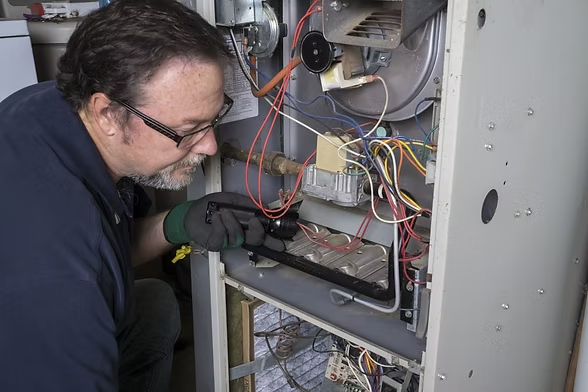
Replace the furnace when one repair crosses half the price of a new system and the unit is already past fifteen. Under that line, fix it. That one rule settles most of the arguments homeowners have with themselves in February, and it settles them with arithmetic rather than dread. A twenty-year-old gas furnace is not automatically junk. It is simply old enough that the money deserves a real look, and any heating contractor gig harbor wa homeowners call during a cold snap should be willing to put that look on paper. Four figures are on the line.
The True Cost Of Nursing An Old Furnace
A homeowner in Bonney Lake called three times across two winters: a flame sensor in November, an inducer motor the following January, then a control board that quit on the coldest night of the year. Those three tickets came to roughly $1,450 before the fourth call was even placed. That is the case we see most often, and it rarely announces itself as a pattern until somebody sits down and adds the receipts. Repairs feel small one at a time. Stacked, they quietly buy a sizable share of a new system.
Age matters for one reason that has nothing to do with money. A heat exchanger that old can crack, and a cracked heat exchanger can leak carbon monoxide into the house while the furnace runs. If a CO alarm sounds, get everyone outside and call 911, then leave the system off until it has been inspected. Do not nurse that one through another season, whatever the repair quote happens to say (this is the single place where the cheap answer is just wrong).
Repair Versus Replace By The Numbers
Four inputs decide it. The repair quote in hand, the age of the unit, the installed price of a mid-range replacement, and the annual savings a new system is estimated to deliver. Say the control board quote is $780 and a mid-range gas furnace installed lands near $6,200, as an illustrative scenario. That repair is roughly twelve percent of the replacement, well under the halfway line, so on paper the fix wins that day. The trouble is that the same furnace produced two other tickets in fourteen months, and the real question is not what this one costs but what the next three will. Efficiency shifts the number too, though less than the brochures suggest: ENERGY STAR, the federal program run by the Environmental Protection Agency, reports that a certified furnace in the southern United States is up to 11% more efficient than a standard model, worth about $40 a year. Longer, colder heating seasons change that arithmetic, which is why a heating contractor gig harbor wa homeowners hire should hand over an estimated savings figure beside the install price.
Electrical capacity is the piece almost everybody forgets. A replacement often arrives with a new air handler, sometimes a heat pump, and the panel has to carry the load. For scale, MIT News reported in June 2026 that a typical room air conditioner consumes around 1,000 watts, a useful yardstick when you are picturing what a panel is being asked to do. In Washington the permit is not a formality: a permit is required before electrical work starts, and the state Department of Labor and Industries requires an inspection to be requested within 3 business days of the work being completed. Ask for the permit number.
How Old Is Too Old For A Gas Furnace?
Most gas furnaces run 15 to 20 years, and around the twenty-year mark parts get scarce and expensive. A unit that has needed three repairs in two winters is telling you something, even when each ticket looked minor. Age by itself is not a verdict, but age plus a repair pattern usually is.
Does A New Furnace Pay For Itself?
Rarely on efficiency savings alone, and anybody promising otherwise should be asked to show the arithmetic. What a replacement buys is a predictable winter, no emergency call at two in the morning, and equipment sized for the house rather than inherited. Treat the energy savings as a discount on that, not as the reason to sign.
Where The Break Even Point Lands
The break even sits near that fifty percent line, adjusted for age. A $780 repair on a twenty-year-old unit that has already absorbed $1,450 across two seasons is not a $780 decision at all; it is a $2,230 decision heading somewhere north of $3,000. Energy prices are the moving part nobody at the kitchen table controls, and they have turned political: in Britain, The Guardian reported ministers under pressure over household bills after the government took £150 off bills and extended the warm home discount to around 6 million households. Nobody forecasts fuel prices a decade out with confidence, so buy efficiency you can measure.
Run this before the next cold snap, not during one. Pull the last three invoices, total them, and set that number beside a written replacement quote with an estimated savings figure. If the repairs are past half of the replacement and the unit is over fifteen years old, stop paying for parts on a machine that has already told you how the winter will go. If not, fix it and bank the difference. Boring math, and boring is what you want at eleven at night in January.