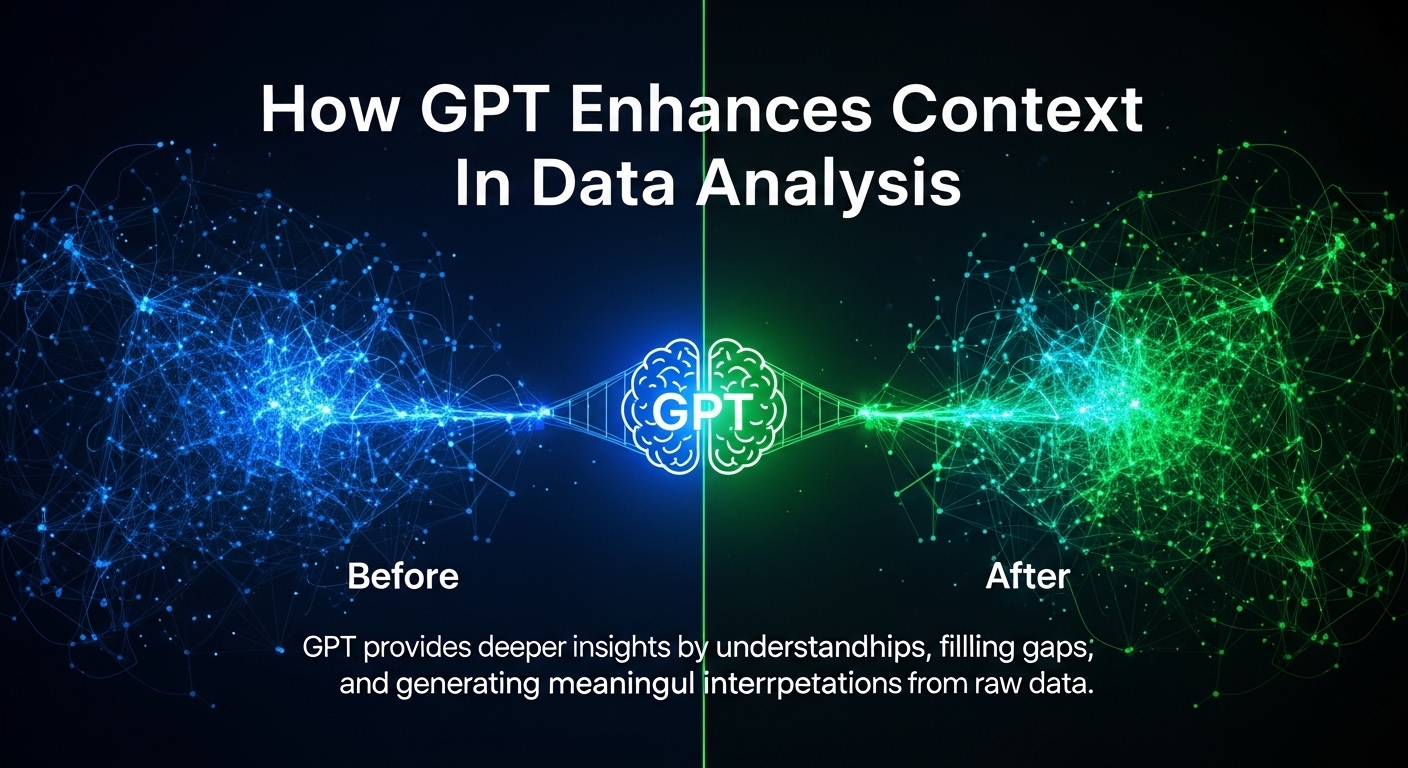
Data analysis rarely fails because of missing numbers. It fails because numbers are viewed without enough context to explain what they represent. As analytics environments grow more complex, metrics become detached from the conditions that produced them. Dashboards show outcomes, but they rarely explain surrounding circumstances, assumptions, or related signals.
This lack of context slows understanding and weakens decision-making. That is why many teams integrate GPT-powered analytics context to restore meaning around data rather than adding more charts or metrics.
Context Is What Makes Data Actionable
Raw metrics are descriptive, not explanatory. A percentage change or trend line shows movement, but not intent or cause. Context explains why data looks the way it does. It connects metrics to campaigns, timing, historical patterns, and related variables.
Without this framing, even accurate data can be misleading. Analytics becomes actionable only when context is present.
Numbers Without Context Create Hesitation
When teams cannot explain results confidently, decisions slow. Stakeholders hesitate because they do not understand what numbers represent beyond surface change.
Dashboards Strip Away Context Over Time
Dashboards are optimized for efficiency. As they evolve, they prioritize compact views over explanatory detail. Context that once lived in notes, conversations, or documentation fades away.
New users see results without understanding the conditions under which those results were generated. Over time, dashboards become disconnected from the story behind the data.
GPT Reintroduces Analytical Context
GPT enhances data analysis by reintroducing context dynamically. Instead of static annotations, GPT evaluates metrics alongside historical behavior, related dimensions, and known patterns.
It frames results within a broader analytical narrative rather than isolating individual data points. This approach restores depth without overwhelming users with manual explanation.
From Isolated Metrics To Connected Signals
GPT helps analysts and stakeholders see how metrics relate to one another. Changes are no longer viewed in isolation, but as part of a larger system.
Historical Context Improves Understanding
One of the most valuable forms of context is historical comparison. GPT references historical baselines to explain whether current behavior is unusual or expected. A drop may be significant or simply seasonal.
A spike may reflect a campaign or a recurring pattern. Without historical framing, teams often misinterpret normal variation as problems.
Cross-Metric Context Reduces Misreading
Metrics rarely change alone. One metric often influences or explains another. GPT enhances context by linking related metrics together. It highlights correlations, dependencies, and supporting signals that help explain why a result occurred. This reduces misinterpretation caused by focusing on single metrics in isolation.
Context Scales Better Than Documentation
Traditional context lives in documentation or institutional knowledge. Both are difficult to maintain at scale. GPT scales context automatically. As dashboards multiply and audiences grow, GPT provides consistent framing without requiring constant updates or manual explanations. This scalability is essential for analytics environments serving multiple teams.
Supporting Business Understanding
Business stakeholders often lack the technical background to infer context from raw data. GPT translates analytical signals into business-relevant framing. It explains how data relates to goals, timing, and performance drivers without requiring deep analytical literacy.
This makes analytics more accessible and reduces dependency on analysts for clarification.
Context Reduces Interpretation Errors
Misinterpretation often stems from missing context rather than incorrect data. When users lack context, they draw conclusions based on assumptions. GPT reduces this risk by supplying relevant framing alongside metrics. Better context leads to better judgment, even when the data is complex.
Embedded Context Improves Workflow Efficiency
Context is most effective when embedded directly into analytics workflows. When explanations appear alongside dashboards, teams do not need to search for background information or ask follow-up questions.
Understanding becomes immediate. This embedded approach aligns with platforms built as a Dataslayer analytics context layer, where context is treated as a core component of analytics rather than an afterthought.
Analysts Focus On Higher-Value Work
When GPT provides baseline context, analysts spend less time explaining obvious patterns. This frees analysts to focus on deeper investigation, strategic insights, and forward-looking analysis rather than repeated contextualization. Context automation improves both efficiency and analytical depth.
Context Evolves With Data
Context is not static. As business conditions change, context must adapt. GPT updates context dynamically as new data arrives. It reflects current behavior rather than relying on outdated explanations or assumptions. This adaptability keeps analytics relevant over time.
When Context Becomes The Missing Link
Teams often add more dashboards to solve understanding problems. This rarely works. The real issue is not visibility but context. GPT addresses this gap directly by enhancing understanding rather than expanding data volume. When analytics reaches this stage, context becomes more valuable than additional metrics.
Context As A Force Multiplier
Context amplifies the value of existing analytics. It improves interpretation, reduces errors, and speeds decision-making. GPT enhances context in data analysis by making meaning explicit rather than implicit. It ensures that numbers are understood within the conditions that produced them.
Why Context Changes Outcomes
Decisions improve when context is clear. Teams act faster, align more easily, and trust insights more deeply. GPT does not replace analysis. It enriches it by surrounding data with the context required to interpret it correctly.
That is why GPT’s ability to enhance context fundamentally changes how analytics is consumed and acted upon.