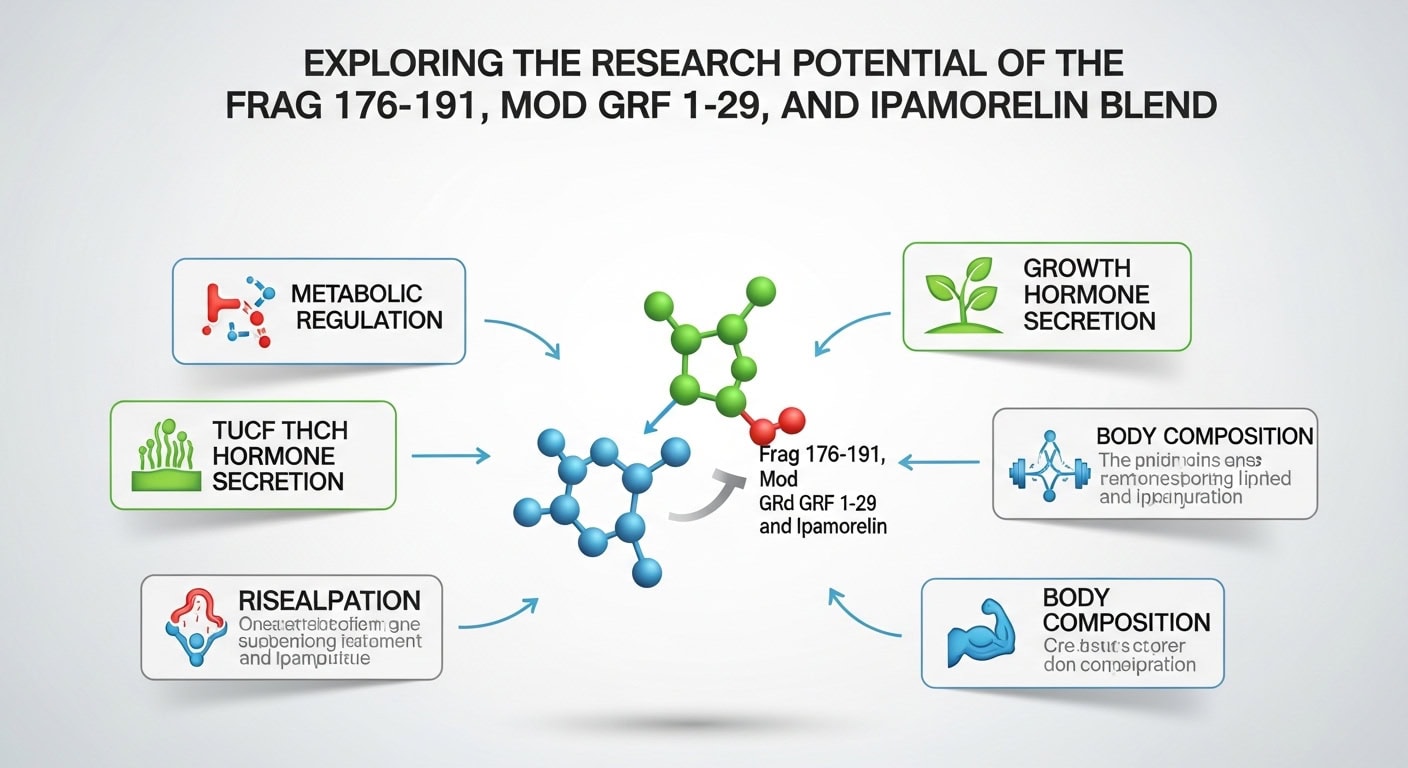
Within contemporary peptide science, increasing attention has been directed toward combinatorial constructs that integrate multiple signaling dimensions into a unified research framework. The blend composed of Frag 176-191, Mod GRF 1-29, and Ipamorelin represents one such tri-modal peptide configuration. Rather than functioning as isolated molecular entities, these peptides are frequently theorized to interact within overlapping endocrine, metabolic, and signaling environments.
Research discourse increasingly frames this blend as a conceptual tool for examining coordinated growth hormone–associated pathways, lipid metabolism signaling, and receptor-specific modulation within the research model. This article explores the molecular identities of each peptide, the hypothesized interactions that arise when they are considered together, and the broader investigative domains in which this blend may hold relevance, while adhering strictly to a speculative and research-oriented perspective.
The Rationale for Peptide Blends in Research
Peptide research has progressively shifted from single-molecule inquiry toward systems-level exploration. This evolution reflects the recognition that biological signaling networks rarely operate in isolation. Instead, cascades of peptide messengers interact across receptors, feedback loops, and temporal rhythms. Within this context, the Frag 176-191, Mod GRF 1-29, and Ipamorelin blend has emerged as a theoretical construct designed to illuminate the coordinated dynamics of growth hormone–related signaling and downstream metabolic processes.
Rather than being viewed as a unified compound, this blend is better conceptualized as a research framework in which three mechanistically distinct peptides are examined simultaneously. Investigations purport that such an approach may allow researchers to explore how discrete signaling biases coexist, reinforce, or modulate one another within complex biological systems.
Frag 176-191: A Lipolytic Signaling Fragment
Frag 176-191 is a peptide fragment derived from the C-terminal region of growth hormone. Unlike full-length growth hormone, this fragment has been theorized to retain signaling properties associated primarily with lipid metabolism rather than growth promotion. Research literature often frames Frag 176-191 as a selective signaling fragment whose molecular structure may favor pathways associated with adipose tissue regulation.
Within research models, Frag 176-191 is believed to serve as a probe for investigating how partial hormone fragments interact with receptors or post-receptor signaling machinery. Its truncated structure has been hypothesized to alter receptor engagement patterns, potentially allowing researchers to isolate lipid-associated signaling cascades without fully activating growth-associated pathways.
From a mechanistic standpoint, Frag 176-191 is frequently discussed in relation to cyclic AMP signaling and hormone-sensitive lipase activity. While definitive mechanistic conclusions remain elusive, research indicates that this fragment might modulate lipid mobilization processes within the research model in a manner distinct from intact growth hormone. This selective signaling property positions Frag 176-191 as a valuable research molecule for studying metabolic partitioning and signal specificity.
Mod GRF 1-29: Hypothalamic Signal Amplification
Mod GRF 1-29 is a modified analog of growth hormone–releasing hormone, truncated to the biologically active N-terminal region. Structural modifications, including amino acid substitutions, have been theorized to enhance molecular stability and receptor affinity. In research discourse, Mod GRF 1-29 is commonly described as a signaling amplifier that may enhance endogenous growth hormone pulsatility within experimental systems.
Unlike direct hormone analogs, Mod GRF 1-29 is positioned upstream within the endocrine signaling hierarchy. Research indicates that it might interact primarily with receptors associated with hypothalamic-pituitary communication, offering insight into regulatory rhythms rather than static hormone levels. This characteristic makes Mod GRF 1-29 particularly valuable for investigating temporal signaling patterns and feedback regulation.
Within the context of peptide blends, Mod GRF 1-29 is often theorized to function as a priming signal. By potentially enhancing growth hormone–related signaling readiness, it may create a biochemical environment in which downstream peptides exert more pronounced or more selective impacts. Such hypotheses remain central to ongoing exploratory research.
Ipamorelin: Selective Ghrelin Receptor Engagement
Ipamorelin belongs to the class of growth hormone secretagogues and is characterized by its high selectivity for the ghrelin receptor, also known as the growth hormone secretagogue receptor. Unlike earlier members of this peptide class, Ipamorelin has been described as exhibiting minimal interaction with receptors associated with stress or appetite signaling in research models.
This receptor selectivity has positioned Ipamorelin as a refined molecular tool for examining ghrelin-mediated signaling pathways. Research suggests that Ipamorelin may activate intracellular cascades associated with growth hormone release while maintaining a narrow signaling profile. Such specificity is of considerable interest in systems biology, where reducing off-target signaling is essential for isolating pathway dynamics.
Within blended peptide constructs, Ipamorelin is frequently theorized to act synergistically with growth hormone–releasing peptides. Its interaction with ghrelin receptors may complement the hypothalamic signaling initiated by Mod GRF 1-29, resulting in a multi-layered signaling environment suitable for advanced research inquiry.
Conclusion
The Frag 176-191, Mod GRF 1-29, and Ipamorelin peptide blend represents a sophisticated research construct rooted in real biochemical principles and contemporary scientific inquiry. Rather than being defined by any singular outcome, this blend is best understood as a dynamic investigative tool. Research indicates that its value lies in its potential to illuminate coordinated signaling processes, metabolic partitioning, and endocrine rhythm modulation within the organism. Researchers may visit Biotech Peptides for the best scientific articles.
References
[i] Heffernan, M., Summers, R. J., & Horowitz, J. F. (2001). The C-terminal fragment of human growth hormone (176–191) selectively stimulates lipolysis without growth-promoting activity.Journal of Endocrinology, 168(3), 441–447. Click here
[ii] Ng, F. M., Bowers, C. Y., & Barkan, A. L. (2000). Selective actions of growth hormone fragments on lipid metabolism.Endocrinology, 141(11), 3971–3976. Click here
[iii] Bowers, C. Y., Sartor, A. O., Reynolds, G. A., & Badger, T. M. (1991). On the actions of growth hormone-releasing hormone and its analogs.Endocrine Reviews, 12(3), 319–337. Click here
[iv] Raun, K., Hansen, B. S., Johansen, N. L., et al. (1998). Ipamorelin, a novel growth hormone secretagogue, selectively stimulates growth hormone release.Journal of Endocrinology, 157(3), 395–401. Click here
[v] Veldhuis, J. D., Anderson, S. M., & Bowers, C. Y. (2001).
Joint amplification of pulsatile growth hormone secretion by GHRH and ghrelin-like peptides.American Journal of Physiology – Endocrinology and Metabolism, 281(4), E823–E830. Click here