
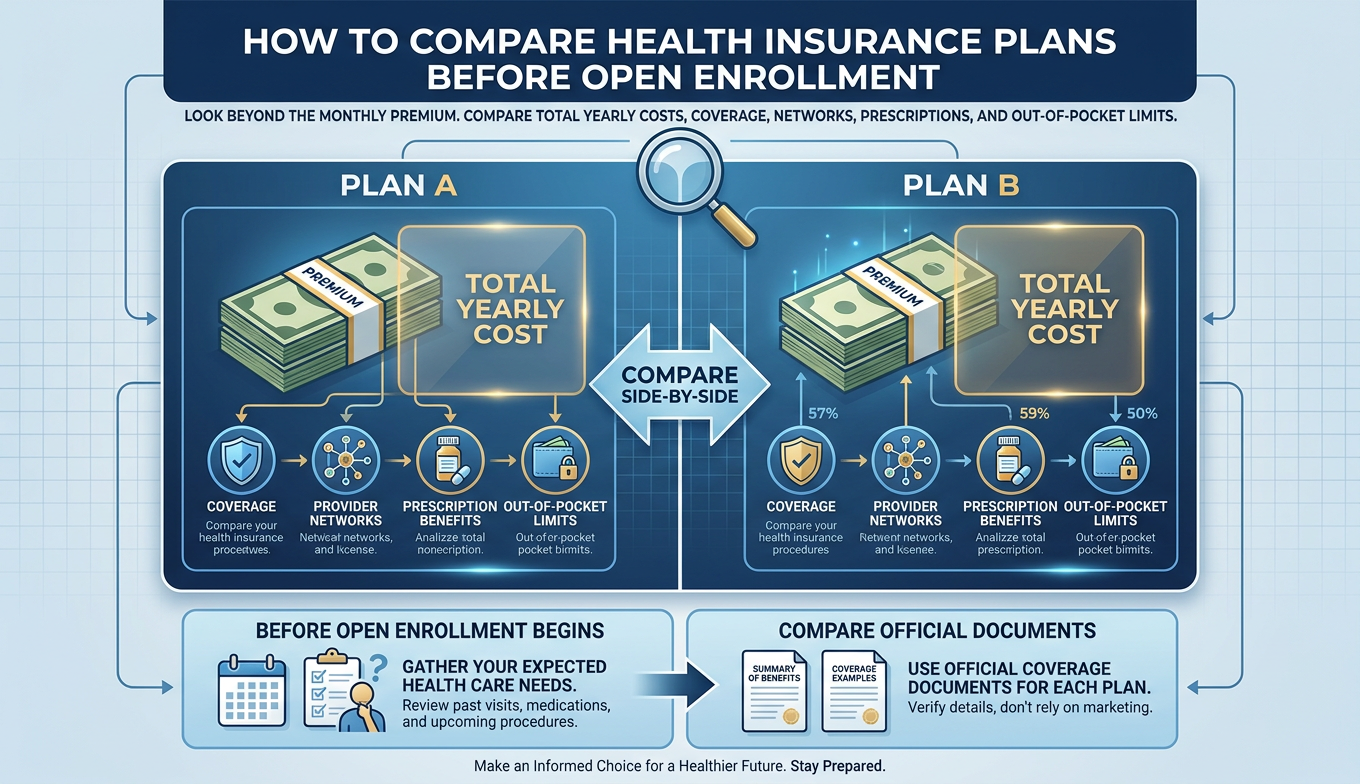
The best way to compare health insurance plans is to look beyond the monthly premium and compare total yearly costs, coverage, provider networks, prescription benefits, and out of pocket limits. Before Open Enrollment begins, gather your expected health care needs and compare each plan side by side using its official coverage documents.
What to Compare Before Choosing a Health Insurance Plan
A health insurance plan should be compared on more than price. The right comparison looks at what you may pay each month, what you may pay when you receive care, which doctors and hospitals you can use, what medicines are covered, and how much financial protection the plan provides during a serious illness.
For most people, the most important comparison points are:
| Factor | What to Check | Why It Matters |
|---|---|---|
| Monthly premium | Monthly amount you pay for coverage | This is your regular fixed cost |
| Deductible | Amount you pay before the plan begins paying for many covered services | A high deductible can create large early year costs |
| Copay | Fixed amount for a covered service | Helps predict the cost of common visits and medicines |
| Coinsurance | Percentage of a covered cost you pay | Can become expensive for hospital or specialist care |
| Out of pocket maximum | Annual limit on covered in network cost sharing | Shows your potential financial exposure |
| Provider network | Doctors, specialists, hospitals and facilities included | An inexpensive plan is less useful if your preferred providers are outside the network |
| Prescription coverage | Covered drugs, tiers, restrictions and pharmacies | Important for anyone who takes regular medication |
| Benefits | Services included and their cost sharing | Determines whether the plan supports your expected medical needs |
| Plan type | HMO, PPO, EPO, POS and other structures | Affects flexibility and out of network coverage |
| Financial assistance | Premium tax credits and other savings | Can significantly change the actual price you pay |
| HSA eligibility | Whether the plan meets applicable requirements | Can matter when comparing high deductible plans |
| Quality information | Available quality ratings and member information | Provides another useful comparison point |
HealthCare.gov specifically recommends looking at total health care costs rather than focusing only on premiums. Marketplace plans also provide information such as plan summaries, provider directories and covered drug lists to support side by side comparisons.
Start Comparing Before Open Enrollment
Waiting until the final days of Open Enrollment can make comparison harder. Start by collecting information that you will need to evaluate plans.
Write down your current doctors, specialists, preferred hospitals, regular medications and expected medical services. Review how often you normally use health care. Include routine appointments, specialist visits, therapy, laboratory services, prescriptions and any known procedures.
Also gather your expected household information for the upcoming coverage year. For Marketplace coverage, household and income information can affect eligibility for savings and the premium you see when comparing plans. HealthCare.gov advises consumers to update expected income and household information when reviewing Marketplace coverage.
This preparation makes the comparison more specific. Instead of asking, “Which plan is cheapest?” you can ask, “Which plan gives me the coverage I need at a manageable total annual cost?”
Understand the Difference Between Premium and Total Cost
The monthly premium is the amount you pay to keep your health insurance active. It is not the same as your total health care cost.
A plan can have a low premium but high costs when you receive medical care. Another plan may have a higher premium but lower deductibles, copays or coinsurance.
For example, consider two hypothetical plans:
| Cost | Plan A | Plan B |
|---|---|---|
| Monthly premium | $250 | $400 |
| Annual premium | $3,000 | $4,800 |
| Deductible | $6,500 | $2,000 |
| Specialist copay | $70 | $35 |
| Coinsurance | 30% | 20% |
| Out of pocket maximum | $9,000 | $6,500 |
Plan A looks cheaper because the monthly premium is lower. However, someone who expects frequent medical care could spend much more under Plan A.
Plan B costs $1,800 more in annual premiums, but it may produce lower costs when the person uses health services.
This is why premium alone should not determine the choice.
HealthCare.gov provides tools that allow consumers to estimate yearly health care costs based on expected use of care.
Know What a Deductible Means
A deductible is the amount you pay for covered services before your health plan begins paying for services subject to the deductible.
A plan with a $5,000 deductible does not necessarily require you to pay $5,000 for every type of health service before insurance contributes. Certain services may have different cost sharing, and preventive services can receive special treatment under applicable rules.
When comparing deductibles, check the details rather than looking only at the headline number.
Important questions include:
| Question | What to Check |
|---|---|
| Is the deductible individual or family? | See how the deductible works for each covered person |
| Does it apply to prescriptions? | Check the drug benefit carefully |
| Does it apply to specialist visits? | Review the plan’s cost sharing |
| Does it apply to hospital care? | Check hospital and outpatient facility costs |
| Are some services covered before the deductible? | Review the SBC and plan documents |
| Is there a separate deductible? | Some plans can have separate deductibles for certain benefits |
The deductible can have a major effect on your budget, especially during the first months of the plan year.
Compare Copays and Coinsurance
Copayments and coinsurance can affect your actual spending every time you receive care.
A copay is usually a fixed dollar amount for a covered service. Coinsurance is generally a percentage of the allowed cost that you pay after applicable deductibles and other plan rules are met.
For example, a plan may charge:
| Service | Hypothetical Plan 1 | Hypothetical Plan 2 |
|---|---|---|
| Primary care visit | $30 copay | $20 copay |
| Specialist visit | $75 copay | $40 copay |
| Urgent care | $80 copay | $50 copay |
| Generic prescription | $15 copay | $10 copay |
| Hospital coinsurance | 30% | 20% |
Do not assume that a lower copay always means a cheaper plan.
A plan with low office visit copays may have a higher premium or hospital coinsurance. A plan with higher office visit costs may have a lower premium.
Look at the complete cost structure.
Check the Out of Pocket Maximum
The out of pocket maximum is one of the most important figures to review before enrollment.
For covered services subject to the plan’s out of pocket limit, it represents the maximum amount you pay during the plan year for covered cost sharing under the applicable rules. Premiums generally do not count toward this limit. Deductibles, copayments and coinsurance can count.
This number matters because major illness can produce high medical bills.
When comparing plans, ask:
- What is the annual out of pocket maximum?
- Is it individual or family?
- What costs count toward the limit?
- Are premiums excluded?
- Are out of network costs treated separately?
- Are there services or charges that do not count toward the limit?
A lower out of pocket maximum can provide stronger financial protection, even when the monthly premium is higher.
Compare Annual Premiums
Convert the monthly premium into an annual figure before making comparisons.
The basic calculation is:
Monthly premium × 12 = annual premium
For example:
$350 × 12 = $4,200
If a plan has a $350 monthly premium, your annual premium is $4,200 before considering other costs or any applicable financial assistance.
This simple calculation makes it easier to compare plans.
However, Marketplace financial assistance can change the amount you actually pay. Do not compare unsubsidized premiums when the Marketplace provides a different net premium based on your eligibility.
Check Premium Tax Credits and Other Savings
Financial assistance can dramatically change the comparison.
Depending on your circumstances, Marketplace applicants may qualify for premium tax credits or other savings. Cost sharing reductions are also available for eligible consumers who select qualifying Silver plans. HealthCare.gov explains that cost sharing reductions can lower deductibles, copayments and coinsurance, and they apply specifically through Silver plans.
This creates an important comparison rule:
Always compare the actual premium shown for your household after applicable savings, not only the standard listed premium.
A Silver plan that appears more expensive before savings can be more attractive after financial assistance is calculated.
Because eligibility can depend on household and income information, enter accurate information when reviewing Marketplace options.
Understand Bronze, Silver, Gold and Platinum Plans
Marketplace plans are divided into four metal categories: Bronze, Silver, Gold and Platinum.
These categories are about how costs are generally shared between the plan and the consumer. They are not quality ratings.
| Marketplace Category | Plan Pays About | Consumer Pays About | General Deductible Pattern |
|---|---|---|---|
| Bronze | 60% | 40% | Higher |
| Silver | 70% | 30% | Moderate |
| Gold | 80% | 20% | Lower |
| Platinum | 90% | 10% | Lower |
These percentages are averages used for plan categories. Actual cost sharing varies by plan.
Bronze plans generally have lower premiums and higher cost sharing.
Silver plans sit in the middle and can be especially important for people who qualify for cost sharing reductions.
Gold plans generally have higher premiums and lower cost sharing.
Platinum plans generally have the highest premiums and lowest cost sharing among the standard metal categories.
Do not treat Bronze as poor coverage or Platinum as better medical care. The metal category describes financial cost sharing, not the quality of doctors or treatment.
Check Whether a Silver Plan Offers Extra Savings
This deserves separate attention because it can change the entire comparison.
Eligible Marketplace consumers who receive cost sharing reductions must choose a Silver plan to receive those additional savings.
For someone who qualifies, comparing a standard Silver plan with a Silver plan that provides reduced cost sharing can be very different from simply comparing Bronze, Silver and Gold premiums.
Before deciding, check the Marketplace result after your household and income information has been entered.
Understand HMO, PPO, EPO and POS Plans
Plan type determines how you access doctors and other health care providers.
HMO Plans
Health Maintenance Organization plans generally use a network of participating providers and usually do not cover routine out of network care except in emergencies. Some HMOs also require a primary care referral before seeing certain specialists.
An HMO may be suitable for someone who is comfortable using a defined network and wants to manage costs through that network structure.
PPO Plans
Preferred Provider Organization plans generally offer more flexibility. You typically pay less when using in network providers, while out of network care may be available at a higher cost.
A PPO can matter when you want more flexibility in choosing specialists or receiving care outside the network.
EPO Plans
Exclusive Provider Organization plans generally cover care through the plan’s network except for emergencies. They may not provide routine out of network coverage.
POS Plans
Point of Service plans combine features found in HMO and PPO structures. The exact rules vary by plan, so review the specific plan documents rather than relying only on the plan type.
Verify Your Doctors and Hospitals
Provider networks should be checked before enrollment.
Do not assume that a doctor who accepts an insurer will accept every plan sold by that insurer. Network participation can vary by specific plan.
Check:
- Your primary care doctor
- Specialists
- Preferred hospital
- Urgent care centers
- Laboratories
- Imaging facilities
- Mental health providers
- Physical therapy providers
- Pharmacies
HealthCare.gov provides access to provider directories and other plan documents when comparing Marketplace plans.
For important providers, verify participation through the insurer’s current provider directory and, when necessary, directly with the provider.
Check the Exact Hospital Network
Hospital coverage deserves special attention because hospital bills can be large.
A plan may include your regular doctor but exclude the hospital you prefer. Another plan may include the hospital but have different cost sharing for inpatient treatment.
Check the actual facility name rather than relying on the health system’s general brand name.
Large medical systems can have multiple hospitals, clinics and physician groups with different network arrangements.
Compare Prescription Drug Coverage
Prescription coverage should be checked before selecting a plan.
Look at the plan’s formulary, which is the list of covered medications.
Check:
| Prescription Question | Why It Matters |
|---|---|
| Is the drug covered? | A medication outside the formulary may not receive normal coverage |
| What tier is it on? | Drug tiers can affect your cost |
| Is prior authorization required? | The plan may require approval before covering the medicine |
| Is step therapy required? | The plan may require other medications to be tried first |
| Is a specific pharmacy required? | Pharmacy network rules can change your cost |
| Is mail order available? | May affect how maintenance drugs are obtained |
| Is there a quantity limit? | May affect how much medicine is covered at one time |
HealthCare.gov says consumers can review covered drug lists when comparing Marketplace plans.
Check medications by their exact names. If you take a brand name product, also check whether a generic or alternative is listed.
Review Mental Health and Behavioral Health Coverage
Mental health and substance use disorder services are part of the essential health benefits for Marketplace plans.
Even when a benefit exists, the practical cost and access can differ between plans.
Check:
- Outpatient mental health copays
- Coinsurance
- Deductible rules
- Therapist network
- Psychiatrist network
- Telehealth options
- Inpatient behavioral health coverage
- Prior authorization requirements
A plan that looks inexpensive may not be as useful if a preferred therapist or psychiatrist is not in network.
Look at Preventive Care Coverage
Marketplace plans cover preventive services required under applicable rules without cost sharing when provided by an in network provider. HealthCare.gov lists preventive care among the required benefits of Marketplace coverage.
Examples can include certain preventive screenings, immunizations and wellness services.
When comparing plans, still verify how preventive services are defined and whether the provider is in network. The same service can have different costs when it is preventive care versus diagnostic care.
For example, a screening test may be covered differently from a test ordered because a doctor is investigating a symptom.
Review the Essential Health Benefits
Marketplace plans cover 10 essential health benefit categories, including outpatient care, emergency services, hospitalization, prescription drugs, mental health and substance use disorder services, maternity and newborn care, laboratory services, preventive care and pediatric services.
Adult dental and vision coverage are not included as essential health benefits, so check separately for those services.
When comparing a plan, do not stop after seeing that a benefit exists. Look at the cost sharing, limitations, network requirements and other conditions attached to the benefit.
Read the Summary of Benefits and Coverage
The Summary of Benefits and Coverage, often called the SBC, is one of the most useful documents for comparing health insurance plans.
Insurance companies and job based health plans are required to provide an easy to understand SBC. It is designed to make plan comparisons easier and includes standardized information about benefits and coverage.
An SBC can help you compare:
- Deductibles
- Copayments
- Coinsurance
- Out of pocket limits
- Covered services
- Exclusions
- Coverage examples
The SBC also includes standardized examples involving common medical situations such as diabetes care and childbirth.
Use the SBC for each plan rather than relying on an insurer advertisement or a short summary on a comparison website.
Review the Full Plan Documents
The SBC is important, but it may not answer every question.
For complicated coverage needs, review the plan brochure, evidence of coverage, certificate of coverage or equivalent policy document.
Search the documents for terms such as:
“prior authorization”
“referral”
“out of network”
“excluded”
“specialty drugs”
“physical therapy”
“home health”
“skilled nursing”
“durable medical equipment”
“emergency care”
“mental health”
“maternity”
These sections can reveal rules that are not obvious from the premium and deductible.
Check Prior Authorization Requirements
Prior authorization means the insurer requires approval before certain services, treatments or medications are covered under the plan’s rules.
Requirements can apply to some procedures, advanced imaging, specialty medications, therapies and other forms of care.
When comparing plans, check whether a service you expect to use requires prior authorization.
This can affect both cost and the process of receiving care.
Check Referral Rules
Referral requirements can affect how easily you see specialists.
Some plans require you to start with a primary care provider and obtain a referral before receiving certain specialist services. Other plans may allow direct specialist access within the network.
If you regularly see specialists, check this rule before enrollment.
Do not assume that all HMOs, PPOs, EPOs or POS plans have identical referral policies. Review the specific plan.
Compare HSA Eligibility
Health Savings Accounts can be relevant when comparing high deductible health plans.
An HSA can offer tax advantages when the applicable legal requirements are met. However, being described as a “high deductible” plan does not by itself answer every HSA eligibility question.
For 2026, the IRS states that a qualifying high deductible health plan must meet specified deductible and out of pocket requirements. The 2026 HSA contribution limits are $4,400 for self only coverage and $8,750 for family coverage.
These figures are tied to specific tax years and can change. When planning for a later year, check the current IRS guidance rather than relying on an older number.
When evaluating an HSA compatible plan, compare the premium, deductible, out of pocket maximum, employer contribution if applicable, expected medical spending and your ability to fund the HSA.
Calculate Low, Medium and High Use Cases
A strong comparison does not depend on only one health care scenario.
Calculate at least three scenarios.
Low Use Scenario
Assume you have few medical visits and mainly use preventive services.
Calculate:
Annual premium + expected routine out of pocket costs
This helps show which plans are affordable when health care use is low.
Medium Use Scenario
Include several primary care visits, one or more specialist visits, prescriptions and routine testing.
This scenario shows whether a higher premium plan begins to provide meaningful savings.
High Use Scenario
Include significant medical care such as hospital treatment, surgery, ongoing specialty care or expensive prescriptions.
Compare the total annual premium and potential out of pocket spending.
The goal is not to predict exactly what will happen. It is to understand how each plan behaves under different levels of health care use.
Compare Best Case and Worst Case Costs
Two numbers can be especially useful.
Estimated Annual Cost
A basic estimate is:
Annual premium + expected covered out of pocket spending
Maximum Potential Cost
A simple planning estimate can be:
Annual premium + applicable out of pocket maximum
This is not a complete calculation for every policy situation. Out of network expenses, noncovered services, premiums and other charges may be treated differently.
Still, it provides a useful way to compare the financial risk of plans.
A plan with a slightly higher premium but much lower out of pocket exposure can be worth considering for someone concerned about large medical expenses.
Compare Employer Plans and Marketplace Plans Correctly
Not everyone chooses health insurance through the Marketplace.
Many workers receive coverage through an employer. Employer plans can have their own Open Enrollment dates, benefit structures and rules.
HealthCare.gov notes that job based plans can have different Open Enrollment periods from the Marketplace.
When comparing employer plans, request the SBC and compare:
- Employee premium
- Family premium
- Deductible
- Copays
- Coinsurance
- Out of pocket maximum
- Employer contributions
- Network
- Prescription coverage
- HSA or other account options
Do not compare only the monthly payroll deduction.
An employer plan with a slightly higher employee contribution may provide substantially lower medical cost sharing.
Check Family Deductibles Carefully
Family coverage can be more complicated than individual coverage.
Review whether the plan has individual and family deductibles and how costs are applied when multiple family members need care.
Also compare the individual and family out of pocket maximums.
For families with different medical needs, calculate expected expenses for each household member. One person may require frequent specialist visits while another may use little care.
The cheapest family premium is not necessarily the cheapest total family option.
Check Whether Your Preferred Pharmacy Is in Network
Prescription coverage is not only about the drug list.
Pharmacy networks can also affect your costs.
Check whether your regular pharmacy is included and whether the plan has preferred pharmacies.
A medication can have one cost at a preferred pharmacy and another cost elsewhere.
For expensive or regular prescriptions, compare the complete pharmacy benefit rather than just the generic drug copay.
Review Telehealth Coverage
Many health plans offer telehealth services, but the cost and provider availability can differ.
Check:
- Virtual primary care
- Virtual urgent care
- Telepsychiatry
- Specialist telehealth
- Copay or coinsurance
- Deductible rules
- Participating telehealth providers
Telehealth coverage can be especially useful when it is included at a predictable cost.
Check Emergency and Urgent Care Rules
Emergency coverage should be reviewed before enrollment because cost sharing can be significant.
Check how the plan handles:
- Emergency room care
- Urgent care
- Ambulance services
- Emergency treatment outside the normal service area
Also understand the difference between emergency care and routine out of network treatment.
Look at Plan Quality Information
Cost should not be the only comparison point.
Where available, review plan quality ratings and member experience information.
HealthCare.gov makes clear that metal categories do not indicate quality. They describe cost sharing between consumers and plans.
Quality information can therefore serve a different purpose from Bronze, Silver, Gold or Platinum classifications.
Use both types of information:
Metal level = how costs are generally shared
Quality information = available information about plan performance and member experience
Use Official Marketplace Comparison Tools
For Marketplace coverage, start with the official Marketplace for your coverage area.
HealthCare.gov allows consumers to preview plans and prices and compare information before completing enrollment. Plan comparison pages can include premiums, benefits, provider directories and covered drug lists.
A state based Marketplace may have its own enrollment website and comparison tools.
When using any comparison tool, verify the final plan information against official plan documents before enrollment.
Do Not Automatically Renew Without Comparing Plans
Automatic re enrollment can be convenient, but it should not replace an annual comparison.
HealthCare.gov explains that Marketplace consumers may be automatically re enrolled if they take no action, but they can still review other plans during Open Enrollment.
Your existing plan may have changed its:
- Premium
- Deductible
- Copays
- Provider network
- Drug coverage
- Benefits
- Plan availability
Compare the new year plan with the available alternatives before assuming your existing plan is still the best fit.
Check Whether Your Current Plan Is Changing
Insurance companies can change or discontinue plans.
HealthCare.gov advises consumers to review available plans during Open Enrollment if their current plan is no longer being offered or if changes affect their coverage.
Read the renewal notice carefully.
Do not assume that a plan with the same name has exactly the same benefits in the next coverage year.
Check the new year’s SBC and other updated documents.
Avoid These Common Health Insurance Comparison Mistakes
Choosing the Lowest Premium
A low premium does not guarantee a low total cost.
A high deductible, high coinsurance or high out of pocket maximum can make a low premium plan expensive when you need care.
Ignoring the Provider Network
Your preferred doctor may accept an insurer but not your specific plan.
Always check the exact plan network.
Ignoring Prescription Coverage
A plan that covers your doctor but not your regular medicine may create unnecessary costs.
Review the formulary and pharmacy rules.
Comparing Only Metal Levels
Bronze, Silver, Gold and Platinum give a general idea of cost sharing. They do not tell you every detail about the plan.
Two Silver plans can have very different premiums, networks, drug lists and cost sharing.
Ignoring Financial Assistance
A plan’s listed premium may not be the amount you actually pay after applicable savings.
Enter accurate information to determine your real cost.
Assuming Last Year’s Coverage Is the Same
Benefits and networks can change each year.
Review the new year’s documents.
Forgetting the Out of Pocket Maximum
A plan may have a low premium but a high maximum.
Consider how much you could realistically afford during a serious medical event.
Failing to Check HSA Rules
Not every high deductible plan should be assumed to be HSA eligible.
Check the plan and current IRS requirements.
Know the Marketplace Open Enrollment Timing
For the federal Marketplace, Open Enrollment generally runs from November 1 through January 15 each year. HealthCare.gov states that the December 15 deadline generally applies for coverage to start January 1, while enrollment through January 15 generally results in February 1 coverage, provided other requirements are met.
Employer plans may use different dates.
State based Marketplaces can also have different rules or deadlines.
Because enrollment rules can change, check the official Marketplace or employer benefits materials for the exact year you are enrolling.
Review Your Coverage Before the Deadline
Use the days before enrollment to complete the comparison rather than waiting until the final day.
A useful sequence is:
Gather information → list health needs → identify doctors and medicines → collect plan documents → compare premiums → compare deductibles → compare copays and coinsurance → check networks → check prescriptions → calculate yearly costs → review financial assistance → confirm the final plan
This process reduces the chance of choosing a plan based on only one attractive number.
What to Check When Comparing Health Insurance Plans
A health insurance plan comparison should answer these questions clearly:
How much will I pay every month?
Look at the actual premium after applicable savings.
How much will I pay before the deductible is met?
Review the deductible and services covered before the deductible.
How much does routine care cost?
Check primary care, specialist, urgent care and therapy costs.
How much could serious medical care cost?
Review hospital, surgery and coinsurance rules.
What is the out of pocket maximum?
This helps estimate your financial exposure for covered care.
Can I keep my doctors?
Check the exact plan network.
Can I use my preferred hospital?
Verify the facility in the current provider directory.
Are my medicines covered?
Check the formulary and drug tier.
Do I need referrals?
Review the plan’s specialist access rules.
Do I need prior authorization?
Check services and medicines that require approval.
Is the plan HSA eligible?
Verify eligibility instead of relying only on the term “high deductible.”
Do I qualify for additional savings?
Check Marketplace eligibility and whether Silver cost sharing reductions apply.
Frequently Asked Questions
What is the most important thing to compare when choosing health insurance?
The most important comparison is your total potential cost combined with the coverage you actually need. Compare the premium, deductible, copays, coinsurance, out of pocket maximum, provider network and prescription coverage together. HealthCare.gov specifically advises consumers to consider total health care costs rather than focusing only on premiums.
Is a higher premium health insurance plan always better?
No. A higher premium does not automatically mean better coverage or better quality. It may provide lower cost sharing, but the value depends on the plan’s benefits, network, prescriptions and your expected use of care.
Is a low deductible always better?
Not necessarily. A low deductible can reduce what you pay when using care, but the plan may charge a higher monthly premium. Compare the full annual cost instead of judging the deductible by itself.
Which is usually better, HMO or PPO?
Neither is automatically better. An HMO may work well for someone comfortable with a specific network. A PPO may be useful for someone who values greater provider flexibility. The actual plan network and cost structure matter more than the label alone.
What should I check before renewing my current health insurance plan?
Check the new premium, deductible, out of pocket maximum, provider network, prescription formulary, benefits, copays and coinsurance. Also compare the current plan with other plans available during Open Enrollment.
Should I compare health insurance plans every year?
Yes. Annual comparison is useful because premiums, benefits, provider networks, prescription rules and plan availability can change. Marketplace consumers can review available plans during Open Enrollment instead of simply accepting automatic re enrollment.
What is the difference between a deductible and an out of pocket maximum?
The deductible is the amount you generally pay for certain covered services before the plan begins paying according to its rules. The out of pocket maximum is the annual limit on covered cost sharing under the plan’s rules. They are different numbers and serve different purposes.
Do premiums count toward the out of pocket maximum?
Generally, no. Premiums are separate from covered cost sharing and are not included in the out of pocket maximum.
Why is the Summary of Benefits and Coverage important?
The SBC provides a standardized, plain language overview of benefits and cost sharing. It is designed to make health plan comparisons easier and includes standardized coverage examples.
Can I enroll in Marketplace insurance after Open Enrollment?
Usually, Marketplace enrollment outside Open Enrollment requires eligibility for a Special Enrollment Period, although Medicaid and CHIP have different enrollment rules. Certain life events can create a Special Enrollment Period.
Can I keep my current doctor if I change plans?
Possibly, but it depends on the new plan’s network. A doctor who participates with an insurance company may not participate in every plan offered by that company. Check the specific plan’s current provider directory.
What information should I have ready before comparing plans?
Have your household information, expected income where applicable, current doctors, specialists, hospitals, prescriptions and expected medical care needs ready. This allows a more accurate comparison.
How can I compare two health insurance plans quickly?
Start with five figures: annual premium, deductible, out of pocket maximum, routine care costs and prescription costs. Then verify the provider network and major benefits. After that, review the complete SBC and plan documents.
Health Insurance Comparison Checklist
Before selecting a plan, confirm each item:
| Check | Completed |
|---|---|
| Annual premium calculated | ☐ |
| Deductible reviewed | ☐ |
| Out of pocket maximum reviewed | ☐ |
| Primary care cost checked | ☐ |
| Specialist cost checked | ☐ |
| Hospital cost checked | ☐ |
| Prescription formulary checked | ☐ |
| Preferred pharmacy checked | ☐ |
| Primary doctor verified | ☐ |
| Specialists verified | ☐ |
| Preferred hospital verified | ☐ |
| Referral rules reviewed | ☐ |
| Prior authorization rules reviewed | ☐ |
| Mental health coverage reviewed | ☐ |
| Preventive care rules reviewed | ☐ |
| HSA eligibility checked | ☐ |
| Financial assistance reviewed | ☐ |
| SBC reviewed | ☐ |
| Total yearly cost estimated | ☐ |
| High use cost estimated | ☐ |
| Enrollment deadline confirmed | ☐ |
| First premium payment requirements checked | ☐ |
Key Health Insurance Terms to Remember
Premium: The regular amount paid for health insurance coverage.
Deductible: The amount a person generally pays for certain covered services before the plan starts paying according to its benefit rules.
Copayment: A fixed amount paid for a covered service.
Coinsurance: A percentage of the cost of a covered service that the consumer pays under the plan’s rules.
Out of pocket maximum: The annual limit on covered cost sharing under applicable plan rules.
Network: Doctors, hospitals and other health care providers contracted with the health plan.
Formulary: A plan’s list of covered prescription drugs.
Prior authorization: Approval that may be required before a plan covers certain services, treatments or drugs.
Referral: An authorization or direction from a primary care provider that may be required before seeing certain specialists.
Metal level: The Marketplace categories Bronze, Silver, Gold and Platinum that describe general cost sharing between a plan and its members.
Open Enrollment: The annual period when eligible consumers can enroll in or change Marketplace coverage. For the federal Marketplace, the standard period is November 1 through January 15.
Also Read: Working with a Financial Advisor: A Smart Move for Growing Families
Final Comparison Formula
A practical comparison can be reduced to four financial questions:
Annual premium = monthly premium × 12
Estimated annual health care cost = annual premium + expected covered out of pocket spending
High use planning cost = annual premium + applicable out of pocket maximum
Net plan value = coverage you need + providers you can use + medicines covered + financial protection relative to total cost
These formulas are comparison tools, not guarantees of what you will actually spend. Actual costs depend on the services you receive, provider network, negotiated rates, plan rules, eligibility and other factors.
The strongest health insurance comparison is therefore not simply the plan with the lowest premium. It is the plan whose total cost, coverage, network and financial protection match the health care needs and budget of the person or household enrolling.