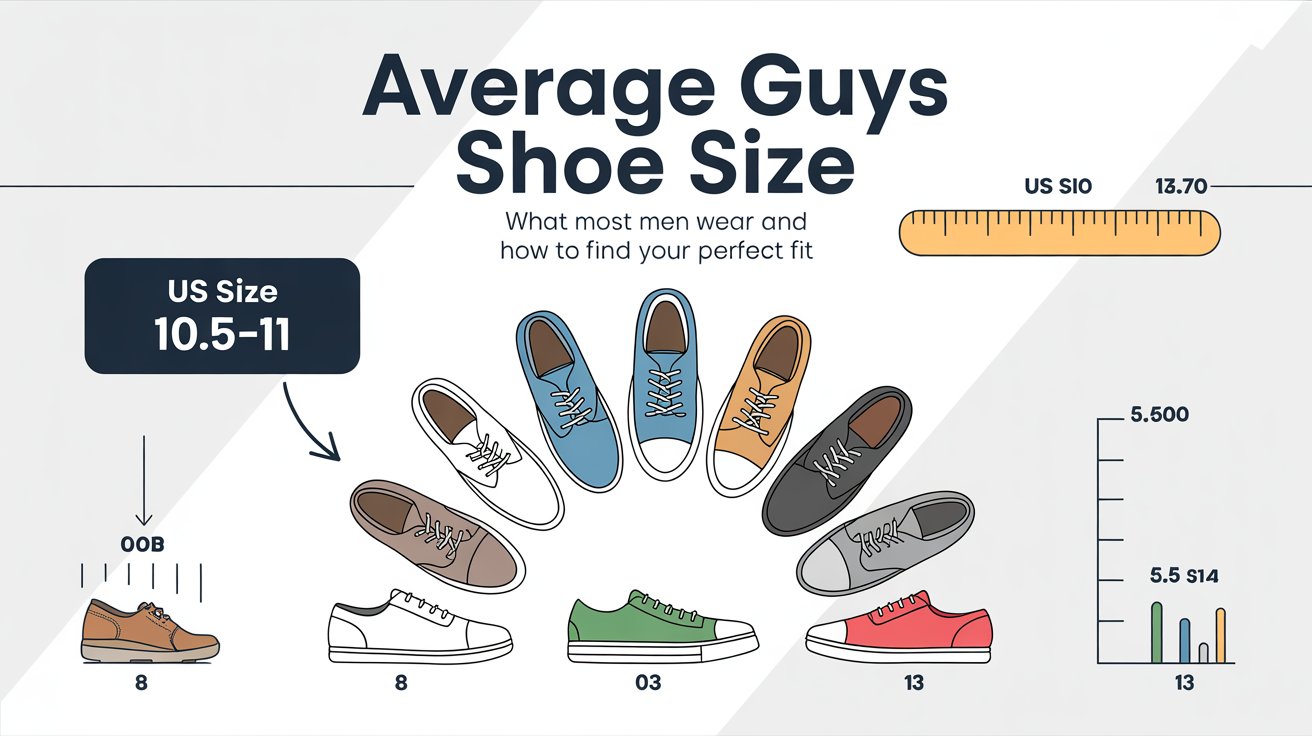
The Average Guys Shoe Size in the United States is roughly 10.5 to 11 (US). That’s the easy takeaway — most grown men land around that range, though individual averages change by country, age, and genetics.
Why that number is the headline
That range comes from population studies and footwear industry measurements taken over recent years. Men have gotten slightly taller and their feet a little bigger than decades ago, which nudged the average up.
Remember this is a population average, not a rule for any one person. Lots of men wear sizes smaller or larger than 10.5–11 and still fall well inside a totally normal range.
If you live outside the US, the raw number will look different. Size systems vary between US, UK, and EU, so the same foot will show as different numbers depending on the chart.
What the average looks like around the world
In the UK, the typical adult male shoe size tends to sit around 9 to 10 (UK). In continental Europe the common range is about 43 to 44 (EU).
Those are rough equivalents, not exact conversions, because brands and last shapes change how a size fits. Use those numbers as general markers rather than fixed rules.
Cultural and genetic factors matter. Populations with taller average height usually show slightly larger average shoe sizes. Diet and early life health can also have subtle long term effects.
Classic menswear trends often return quietly, just like the polo coat, which has made a strong comeback in modern style without most people noticing.
Why shoe sizes vary so much between brands
Manufacturers use different lasts and molds, so a size 10 from one brand can feel like a size 9.5 from another. That’s why trying shoes on still matters even when you know your number.
Materials change how a shoe fits after a few wears. Leather stretches, knit uppers loosen, and rigid synthetics stay the same shape.
Retailers often list a “fit note” like narrow or wide. Those words matter more than the printed number because they describe how the shoe will hug your foot.
Looking back at 1930s mens fashion also helps explain why footwear sizes, fits, and style preferences evolved alongside changes in men’s clothing.
How to measure your foot the right way
Place your foot solidly on a sheet of paper, stand up, and trace the outline while bearing weight. That gives you the real standing length and width.
Measure from the heel to the tip of the longest toe in centimeters and inches. Do the same on the other foot. Most people have a dominant foot that’s slightly bigger.
Always use the larger measurement when checking a size chart. If you’re between sizes, it’s usually safer to size up rather than down.
Quick size reference and what it means for you
If your foot length is close to 27 centimeters, you’ll typically fall around US 9.5 to 10. If your foot is closer to 28 centimeters you’re often around US 10.5 to 11.
These are approximations because shoes have internal volume beyond just length. Width and arch shape change how a shoe feels.
Best practice is to check the brand-specific size chart and compare your actual foot length. That reduces guessing and returns.
Smart online shopping tips
Check the brand’s size chart every time you buy. Don’t assume your size is the same across all makers and styles.
Read recent user reviews for fit clues. Reviewers will tell you if a shoe runs big, small, narrow, or wide.
Keep return policies in mind. Free returns remove the risk of trying two sizes and keeping the better fit. If returns cost money, size carefully.
Common sizing mistakes to avoid
Ignoring width is one of the biggest mistakes. A shoe that’s correct in length but narrow can cause pain and blisters.
Buying shoes early in the day can lead to a too-tight fit because feet swell slightly later on. Try shoes later in the afternoon when feet are at normal daily size.
Assuming you need an exact numeric match to every shoe is wrong. Fit matters more than a number on a label.
Final takeaway you can use
The Average Guys Shoe Size gives a useful benchmark: if you’re around US 10.5 to 11, you’re in the common range for adult men in the US. That doesn’t replace measuring your feet or trying shoes on.
Measure both feet, use the larger size for charts, and check brand-specific guidance. That simple approach will save you money and discomfort.