
Quick summary
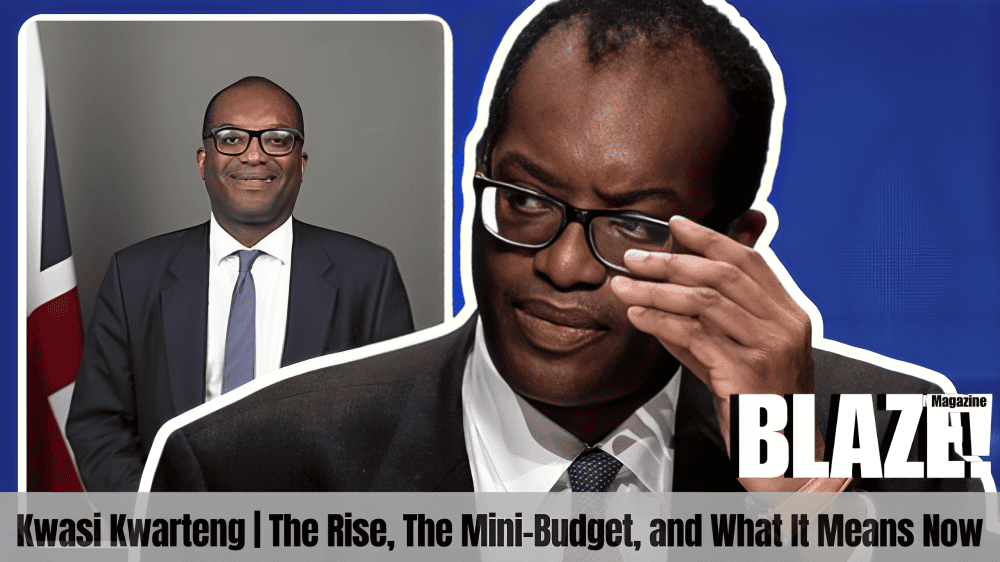
Kwasi Kwarteng is a British Conservative politician and historian known for his fast rise and a brief, highly consequential spell as Chancellor of the Exchequer in 2022. He served as MP for Spelthorne and held senior government roles in business and energy.
Who he is
- Full name: Akwasi Addo Alfred Kwarteng.
- Born: 26 May 1975 in London.
- Education: King’s Scholar at Eton, double first in history at Trinity College, Cambridge.
These facts matter because they shape how he communicates and the networks he uses in politics.
For readers interested in learning about personalities connected to major public figures, explore our profile on Mary Joan Schutz — a detailed look at her life, relationships, and influence.
Kwasi Kwarteng – Quick Biography
| Field | Details |
|---|---|
| Full Name | Akwasi Addo Alfred Kwarteng |
| Known As | Kwasi Kwarteng |
| Date of Birth | May 26, 1975 |
| Age (as of 2025) | 50 years |
| Birthplace | Waltham Forest, London, England |
| Nationality | British |
| Education | Eton College; Trinity College, Cambridge (PhD in Economic History) |
| Profession | Politician, Historian, Writer |
| Political Party | Conservative Party (UK) |
| Constituency | Spelthorne (2010–Present) |
| Former Positions | Chancellor of the Exchequer (2022), Secretary of State for Business, Energy and Industrial Strategy (2021–2022) |
| Spouse | Harriet Edwards |
| Children | One daughter |
| Parents | Alfred K. Kwarteng (economist) and Charlotte Boaitey-Kwarteng (lawyer) |
| Religion | Christian |
| Net Worth (Estimated) | Around £1–2 million |
| Famous For | Delivering the 2022 “mini-budget” as Chancellor |
| Books Authored | Ghosts of Empire, War and Gold, Gridlock Nation, among others |
| Current Status | Serving as MP, commentator, and writer |
Political rise — clear milestones
Kwasi Kwarteng entered Parliament in 2010 as MP for Spelthorne after a background in finance, journalism and academic history. He co-authored policy papers and books that branded him as an intellectual voice on the right.
He held ministerial roles including Secretary of State for Business, Energy and Industrial Strategy before being promoted to Chancellor in 2022. These roles explain why he was chosen to lead economic strategy under Liz Truss.
Chancellor and the mini-budget — the core event
In September 2022, Kwasi Kwarteng delivered a mini-budget focused on rapid tax cuts and deregulation intended to boost growth.
Markets reacted badly: borrowing costs rose, the pound fell sharply, and the Bank of England intervened to stabilise pension funds. The fallout ended with his dismissal after 38 days as Chancellor. This episode is central to assessing his public record.
Essential detail: critics say the plan moved too far, too fast; supporters argue it was a bold attempt to change long-term incentives.
Immediate aftermath and accountability
Kwasi Kwarteng later said he warned Liz Truss to “slow down” after the mini-budget; he admitted impatience and regretted the execution. Observers saw this as both an admission and a partial defence.
He was replaced by Jeremy Hunt, who reversed major measures to restore market confidence. That reversal underlines the political cost of the mini-budget and defines how Kwarteng’s tenure is remembered.
Policy views in plain terms
- He favors lower taxes, deregulation, and a growth-led economic strategy.
- He has argued that Britain needs a bold supply-side push to regain competitiveness.
- As a historian, he frames policy in long-run national narratives rather than short-term political cycles.
Think of his economic approach as a sprint: fast changes intended to jump-start performance — risky if the track is uneven.
Real-life analogy
Imagine a company deciding to slash prices and cut red tape overnight to boost sales. If customers panic and suppliers demand higher payments, the company’s short-term finances suffer. That’s similar to what happened after Kwasi Kwarteng’s mini-budget: ambitious stimulus, immediate market instability.
This analogy helps explain why rapid policy shifts require careful sequencing and clear market signals.
Public perception and media narratives
Public reaction split into two broad camps:
- Critics see recklessness and poor timing.
- Supporters praise conviction and intellectual clarity.
Media coverage focused on market fallout and political consequences, which quickly overshadowed policy details. That media framing shaped how voters and colleagues judged him.
Career after the Treasury
After leaving the Treasury, Kwasi Kwarteng moved into media, advisory roles and public speaking. He also announced he would stand down as an MP at the next election, a sign of shifting priorities and political recalibration.
This transition is instructive: politicians often shift to influence debates from outside parliament after high-profile setbacks.
You can also read about Sened Teame, another emerging name making waves in modern British discussions on leadership and reform.
How historians and economists see him
As a historian, Kwarteng brings narrative-driven arguments to economics: he wants structural reform rather than only short-term fixes.
Economists’ reactions depended on technical assessments: some welcomed supply-side ambition; others flagged timing and scale as destabilising in an already fragile market environment.
What his record means for policy makers
- Lesson 1: Rapid structural change needs credible sequencing.
- Lesson 2: Market confidence is a policy variable — it can rise or fall based on signals from the government.
- Lesson 3: Political communication must match technical plans to avoid misinterpretation.
Policymakers should treat these lessons as operational rules, not ideological slogans.
Notable quotes
“People got carried away, myself included,” Kwasi Kwarteng said reflecting on the mini-budget, a line that shows both accountability and an attempt to contextualise error.
Another blunt observation from his post-tenure interviews: he warned that moving too quickly would shorten the administration’s life. That prescient warning lends weight to calls for cautious sequencing in reform.
Practical takeaways for voters and observers
- Watch sequencing: policy timing matters as much as content.
- Assess credibility: markets and experts read signals beyond headlines.
- Remember accountability: political leaders bear practical consequences when strategy falters.
These are simple filters to evaluate future economic plans from any politician.

Final assessment — concise
Kwasi Kwarteng is a capable communicator and thinker whose decisive approach produced a major policy experiment that failed to land as intended.
He remains a persuasive voice on economic reform, but the mini-budget episode will be the defining moment of his public career for many observers.
What to watch next
- Any public interventions or books where Kwasi Kwarteng reframes the mini-budget lessons.
- Advisory roles that influence energy or industrial policy.
- Whether he returns to frontline politics or focuses on commentary and consultancy.
These moves will determine whether his influence stays intellectual or becomes operational again.