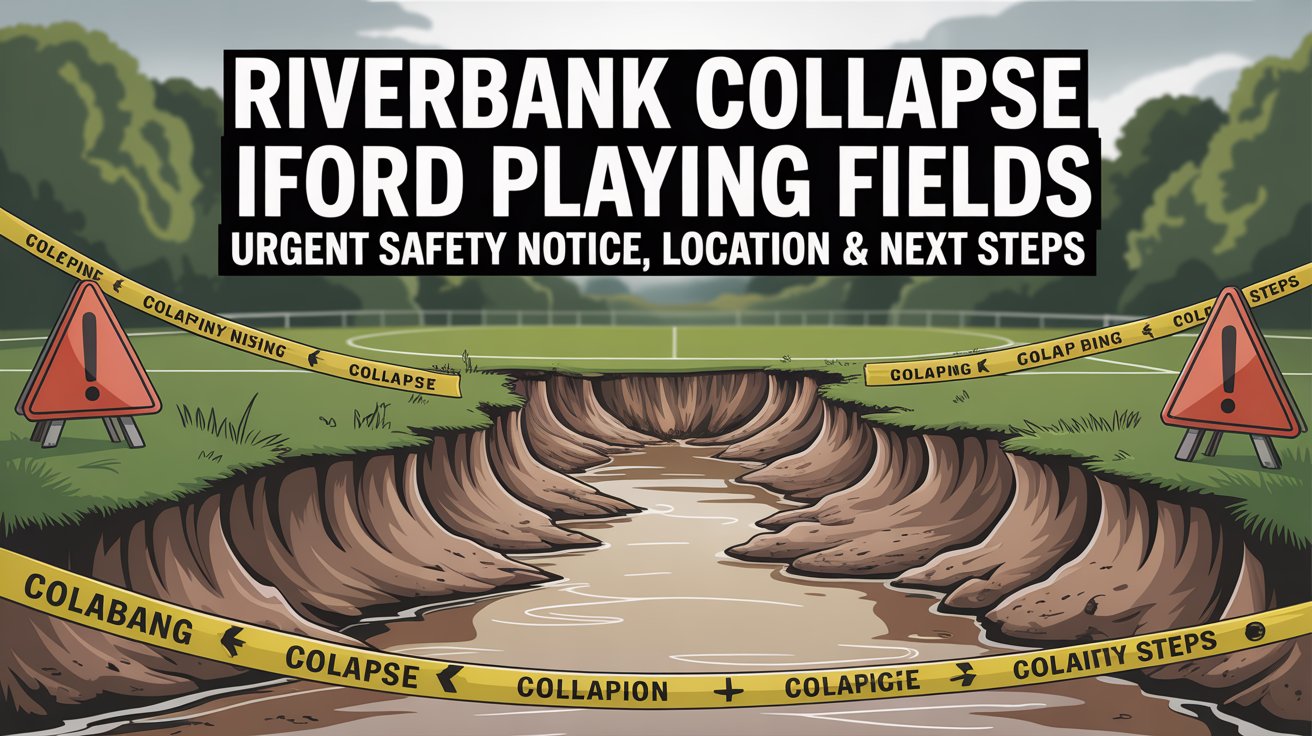
Quick summary: A significant section of the riverbank beside Iford Playing Fields has given way, sending trees and soil into the river and creating an unstable edge close to a public path and a nearby rail bridge. This article explains what happened, where it’s most serious, why it likely failed, the immediate risks, what local authorities are doing, and simple steps residents should take now.
What happened — the incident in plain language
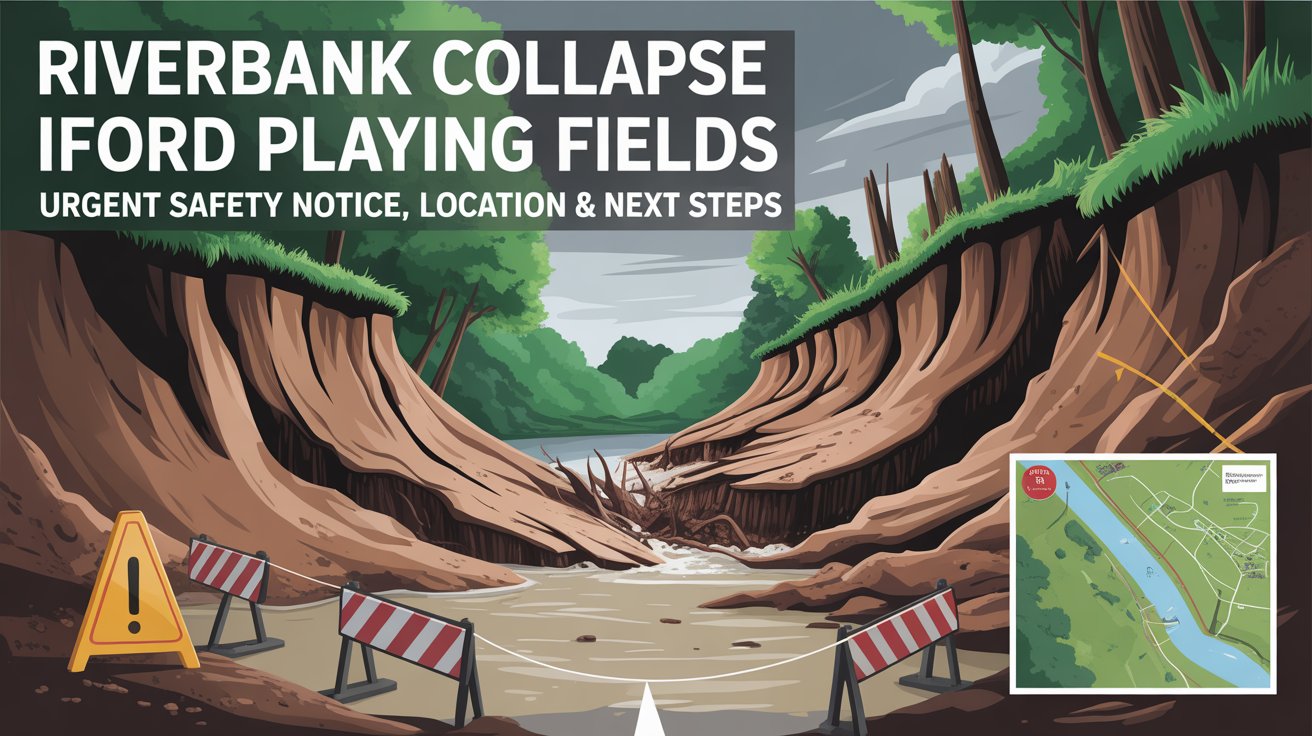
A large stretch of the riverbank next to Iford Playing Fields collapsed, dropping trees and earth into the river and exposing a steep, unsafe edge. Local photos and witnesses show soil and roots missing where the bank once stood.
The failure appears sudden: people walking the area reported seeing the ground “give way” almost overnight, with fallen trees visible from the train bridge and nearby footpaths. Those posts were first shared in community groups and picked up by local outlets.
Important detail: the visible collapse is located near the train bridge opposite Bailey Bridge Marina, meaning both public access routes and infrastructure sit close to the affected zone.
Think of it like the base of a sandcastle being washed away — the top looks fine until the foundation is gone. When a river undercuts a bank, the surface can slump suddenly, bringing trees and paths with it. That’s what happened here.
Exactly where this matters
The failure is at the riverside margin close to Iford Playing Fields, visible from the train bridge and the stretch facing Bailey Bridge Marina. The collapse affects the immediate riverside strip — the area used by walkers, dog-owners, and children accessing the water.
Map-wise, this is the Iford / Bournemouth riverside on the River Stour corridor — a busy local green space that sits inside plans and documents the council keeps for local parks and river paths. That means the location is both publicly used and already part of council green-space planning.
If you use the inland riverside path, note there is a specific short stretch that appears unstable; gates or warning signs may be placed while the council assesses the bank.
Why the bank failed — the most likely causes, in plain terms
Rivers erode from the bottom. When water speed, high flows, or a combination of saturated soils and weather remove material at the base, the bank overhangs and then collapses. At Iford Playing Fields, reports point to recent storms, saturated soil, and possible root failure of large trees that once helped hold the bank together.
Wind and strong weather can accelerate the problem: heavy rain soaks the soil, roots lose grip, and a strong flow or storm surge removes the lower support — then the top slips. Human use — footpaths, informal riverside access, or any nearby disturbance — can make the bank more fragile.
In short: natural erosion + recent weather + loss of root anchoring = sudden bank collapse. That combination is the simplest working explanation based on local evidence.
Immediate risks — what everyone should know now
- Public safety: The exposed edge is unstable; people walking, children playing, or dogs near the collapse risk falling if they approach the bank. Do not walk on the collapsed zone.
- Infrastructure risk: The failure is close to a train bridge. While there’s no public confirmation that the bridge is compromised, any erosion near foundations requires fast monitoring because shifting ground can affect structure safety.
- Environmental impact: Fallen trees and soil in the river can change currents, trap debris, and temporarily harm water quality or fish habitat. Over time, this can alter local channel form and access.
“An unstable bank is not just an ugly gap — it’s a moving danger,” said several local observers; this captures why quick assessment matters.
Similar infrastructure challenges have also been seen elsewhere, such as during the Glasgow Water Main Break Shettleston Road, where sudden ground movement caused major disruption and raised public safety concerns.
What the council and agencies are doing
Local authorities have been made aware and are monitoring the site; council staff regularly include Iford in flood and green-space work, and this collapse has been raised to the relevant teams for inspection and advice. Public posts show the council treats this as part of the river’s natural processes but are taking steps to assess risk.
Expect these immediate actions from council/partners:
- Site inspection to mark unsafe areas and issue closures or signage.
- Risk assessment to check proximity to paths and the rail structure.
- Consultation with environmental and engineering partners on stabilisation options (vegetation, temporary fencing, or structural measures).
At this stage, monitoring and cordoning are common first moves; full repairs usually require surveying and a plan, so short-term signs and restricted access are likely while the technical work is scheduled.
What a practical repair plan usually looks like
- Survey and soil testing to measure how far the failure extends and whether deeper support is needed.
- Temporary fencing and public-warning signage to keep people clear.
- Short-term stabilisation — sometimes placing brushwood, coir rolls, or importing material to shore up the toe.
- Long-term repair — native planting, root-reinforcement, engineered banks (gabions, small stone armour), or moving a path back from the edge.
These steps balance cost, habitat, and durability. In many communities, a combination of planting and gentle engineering works best over time.
How residents and visitors should act now — direct guidance
- Avoid the collapsed edge. Stay at least several metres back; the ground beyond visible cracks can fail without warning.
- Follow posted signs. If the council places barriers, obey them — they’re protecting you.
- Keep dogs on leads near the river. Pets can put pressure on weak sections.
- Report new slips or widening cracks. Send photos and location details to your local council so they can prioritise the site.
- Don’t try to rescue debris from the river yourself. Fallen trees or soil can be treacherous; leave removal to trained teams.
These are straightforward safety steps that protect people while professionals plan repairs.
Real-life analogy and a practical quote to remember
Think of the riverbank like a bookshelf: if the bottom shelf is pulled out, everything above leans and can fall. You can prop the top later, but the immediate danger is the sudden collapse. That’s why stopping access quickly is the simplest and most effective first response.
“Fix the foundation first; everything else is a patch.” This idea matters for riverbanks: without addressing the base and flow, surface repairs won’t last.

What long-term prevention looks like
- Maintain natural vegetation — roots anchor soil. Planting native shrubs and grasses can do more than concrete in many spots.
- Manage footpaths — move trails slightly back from vulnerable edges and create safe viewing points.
- Hydraulic assessment — engineers can model river flow and propose small structural works where needed.
- Community reporting and rapid inspection — local watchers often spot early signs; a formal hot-line or reporting process speeds intervention.
A mix of nature-based solutions and focused engineering usually gives the best long-term resilience.
Final takeaways — what matters most
- The event is real and substantial: trees and bank material fell into the river at Iford Playing Fields; locals and local outlets reported it.
- Public safety is the immediate priority: keep well clear of the damaged edge and follow council signs.
- Fixing this will take assessment and staged work: from monitoring and fencing to longer-term bank stabilisation and possible path re-routing.
If you walk the Iford riverside, treat the collapse as a fresh hazard: give it space, report new changes, and expect follow-up work from the council.
On a lighter note, while local councils manage repair works here, travelers looking for a peaceful retreat can explore Luxury Villas Ibiza Le Collectionist — offering serene stays far from any environmental worries.